Let’s be honest, SEO is full of buzzwords. You’ve probably heard of keyword density, search intent, and maybe even latent semantic indexing.
But have you heard of keyword proximity?
If you’ve never heard of this before, don’t sweat it. You are definitely not the only one. It’s one of those ranking factors that nobody really knows about that works in the background. But once you understand it, you will see a real difference in how content ranks and performs. So let’s break it down as simply as possible.
What is Proximity of Keywords in SEO?To put it simply, keyword proximity is the closeness of your keywords in any given phrase or sentence. When your key terms are appearing right next to one another-or at least very close to one another-it conveys more clearly to search engines what your article is actually about.
Example:
High proximity: “Best digital marketing course online”
Low proximity: “The best course you can take if you’re looking to learn marketing on the internet”
In both examples, the target keyword is “digital marketing course,” but in the first one, the words are closer together and that gives it better proximity.
That’s what keyword proximity in SEO is all about.
Main points of this blog are:
Meaning of keyword proximity
Keyword proximity Vs keyword density
Why focus on keyword density
Keyword Proximity Meaning – Explained Simply
Let’s simplify it even more.
Think of keywords as puzzle pieces. If they’re scattered all over the place, it’s hard to see the full picture. But when they fit closely together? The picture becomes clear for you and for Google.
So, the keyword proximity meaning is essentially:
“How close your target keywords appear together in your content.”
It’s especially important in title tags, headers, meta descriptions, and the first 100 words of your content.
Keyword Proximity Example in Action
Let’s say you’re targeting the keyword “local SEO strategy”.
| Example | Proximity |
| “Build a powerful local SEO strategy now” | High (0 words apart) |
| “Create a strategy for improving your SEO on a local level” | Low (5+ words apart) |
Which one do you think is easier for Google to associate with “local SEO strategy”? You guessed it the first one.
Keyword Proximity vs. Keyword Density: What’s the Difference?
This is where many beginners (and even some SEO managers) get confused. So let’s set it straight.
| Aspect | Keyword Proximity | Keyword Density |
| Definition | Distance between keywords in a phrase | % of how often a keyword appears in content |
| Focus | Closeness of keywords | Frequency of keywords |
| Measurement | Word gap between terms | Percentage of total words |
| Optimization Tip | Keep related terms close — naturally | Aim for 1–2% keyword usage |
| Example (Good) | “Best SEO tools for beginners” (0 word gap) | Keyword used 5 times in 500 words = 1% density |
| Example (Bad) | “Tools are the best for optimizing search engines” (low proximity) | “SEO SEO SEO SEO SEO SEO” (keyword stuffing) |
Summary:
- Keyword proximity is about how close your keywords are
- Keyword density is about how often you use them
Both matter, but don’t overdo either. Google loves balance and natural language.
How Many Keywords Should I Use for SEO?
This is another common question: “How many keywords should I use for SEO?”
Here’s a simple rule of thumb:
- Focus on 1 primary keyword (e.g. “keyword proximity in SEO”)
- Add 3–5 secondary or related keywords (like “what is keyword proximity”, “keyword proximity example”)
- Spread them naturally across your:
- H1 and H2 headings
- First paragraph
- Meta description
- Body content
- Conclusion
Bonus Tip: Don’t repeat the same phrase over and over. Use variations and related terms instead — Google’s smarter than you think.
Why Keyword Proximity in SEO Should Be on Your Radar
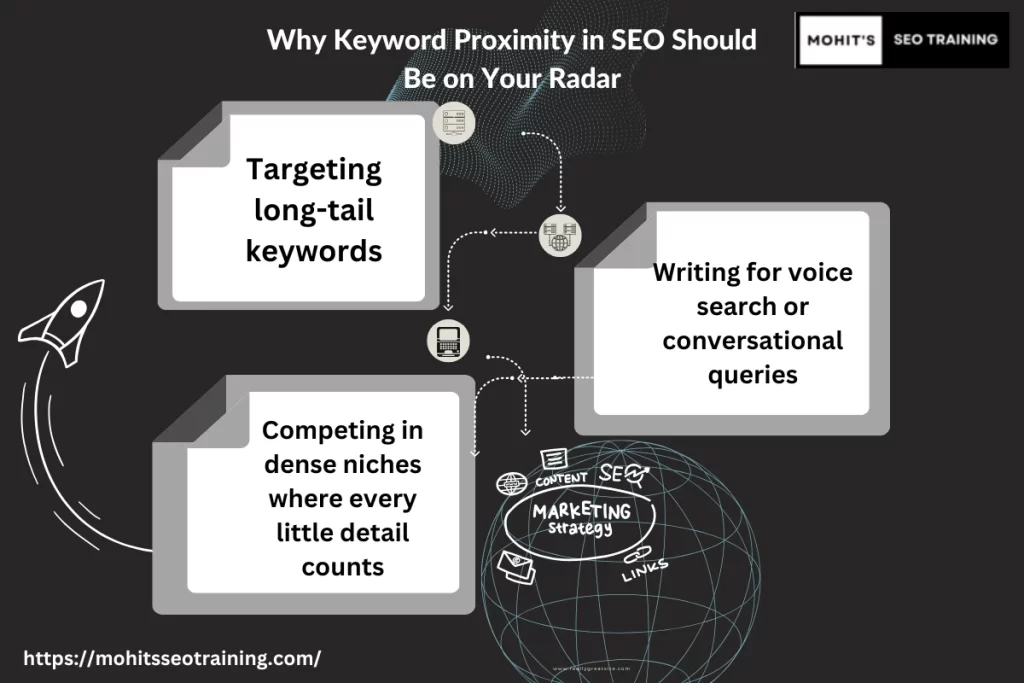
Let’s wrap this up with some clarity: Does keyword proximity really affect SEO?
Yes, especially when you’re:
- Targeting long-tail keywords
- Writing for voice search or conversational queries
- Competing in dense niches where every little detail counts
- High keyword proximity can help you:
- Improve semantic relevance
- Enhance user intent matching
- Increase visibility for exact match queries
It won’t guarantee rankings, but in the SEO world, small tweaks often lead to big wins.
Final Thoughts: Write for People, Optimize for Search
The best SEO content feels human. And that’s what makes keyword proximity so valuable — it naturally fits within content that sounds like real people talking.
So next time you’re creating a blog post, web page, or even an ad, ask yourself:
- Are my keywords too far apart?
- Can I bring them closer without sounding weird?
- Am I writing this for a bot, or for a person who’s actually reading?
If you want to master not just keyword proximity, but real-world SEO that gets results, then you’re in the right place.
- The why behind Google’s algorithm
- How to rank ethically in 2025 and beyond
- Practical strategies that go beyond theory
Whether you’re a student or a seasoned SEO manager, Mohit’s SEO Training got you covered.
Other Related Blogs
Keyword Cannibalization in SEO
Meaning of Keyword Difficulty Score
What is Good Keyword density?
Keyword proximity in SEO
Keyword stuffing in Digital Marketing
Tools used for keyword research
How to do the keyword research?
Keyword prominence in SEO
Importance of keyword research
FAQs
What does keyword proximity mean in SEO?
Keyword proximity is the space (or distance) between two or more keywords in the content of a webpage (especially in a sentence or phrase). The less space (or distance) there is, the better the proximity. Search engines will take this into consideration when verifying how relevant your content is to the inquiry of the user.
Why is keyword proximity important for SEO?
Keyword proximity can serve as a factor when search engines are contemplating how relevant your content is. If keywords appear more closely together, it indicates a greater topic focus and may increase your ability to rank for particular search queries (if they were to be long-tail keywords).
What is an example of keyword proximity?
For example,High proximity: “Best Italian restaurant in town.” Low proximity: “This place is considered the best when you are looking for food, especially something from Italy, like a restaurant.” In the first example, “Italian” and “restaurant” are much closer together making their proximity better.
How many keywords should I use for SEO?
There’s no fixed number, but a good practice is to focus on 1 primary keyword and 2–4 secondary keywords per page. Instead of keyword stuffing, use them naturally in your content, titles, headers, meta descriptions, and image alt text—while paying attention to proximity and placement.
Does keyword proximity affect rankings on Google?
Yes, to some extent. While not a primary ranking factor, keyword proximity can improve relevance and context. Combined with quality content, good structure, and proper keyword placement, it contributes to better SEO performance.

Mohit Verma
Contributor at Mohit's SEO Training.