Imagine picking up a newspaper with no headlines — just walls of text.
Confusing, right?
Just as we look at a headline to make conclusions about what an article is about, search engines also look at the H1 tag to determine what that page is about, and do it in 1/10 of a second.
If you care about an H1 tag’s prominence for SEO, congratulations — you’re beginning to think like an SEO strategist!
For one moment, let’s put on our SEO professional hats, and walk through why an H1 tag matters, how the H1 tag affects search rankings, and how to use H1 tags strategically to get your site more visibility.
In this blog, we’ll break down:
What good is an H1 Tag?
How Important are H1 Tags for SEO?
What is the Value of H1 in SEO?
What is the Importance of Heading Tags for SEO?
How to Write an Effective H1 Tag: Quick Best Practices
Different Tools to Audit H1 Tags
What good is an H1 Tag?
In simplified terms, an H1 tag behaves like the heading of your webpage.
It is the first thing both people and search engines see when they reach your page.
Here’s what the H1 tag does:
- Sets the context: It tells visitors and bots what your page is mainly about.
- Creates hierarchy: It marks the beginning of your content structure.
- Enhances readability: A clear H1 makes it easier for users to scan and stay engaged.
Think of your H1 like the title of a book. Without a proper title, readers (and Google) might have a harder time understanding what they’re about to dive into.
Example:
If your page is about growing tomatoes at home, your H1 could be:
“The Ultimate Guide to Growing Organic Tomatoes at Home”
This instantly sets the scene, both for readers and search engines.
What is the Value of H1 in SEO?
Let’s dig deeper.
The value of the H1 in SEO isn’t just technical — it’s practical too.
Here’s why:
- Guides user intent: A clear H1 reassures users they are in the right place.
- Supports SEO hierarchy: Search engines look at H1s first before analyzing H2s, H3s, and so on.
- Boosts dwell time: Visitors are more likely to stay and read if your heading immediately connects with what they searched for.
In competitive industries, where every second counts, a powerful H1 can be the difference between a user bouncing back to Google — or staying on your site.
How to Write an Effective H1 Tag: Quick Best Practices
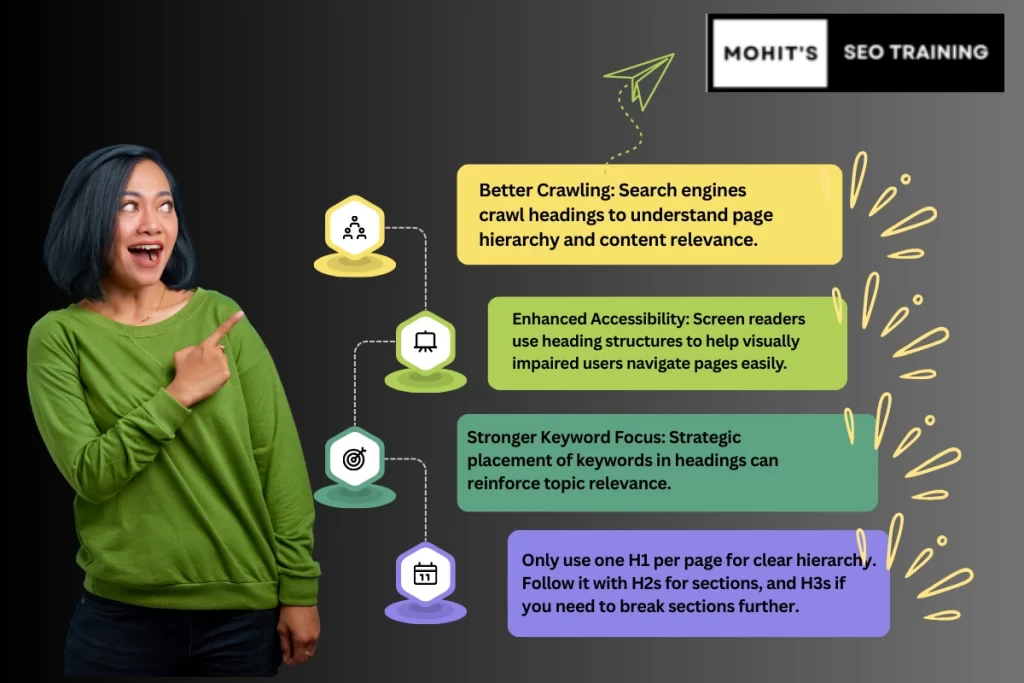
Keep it Clear and Relevant: Your H1 should immediately communicate the topic.
Use Your Main Keyword Naturally: Don’t force it; make it fit the flow of the title. Make it Engaging: Think like your audience — what headline would you click on? Avoid Multiple
H1s: One page = one H1.
Align with Your SEO Goals: Make sure the H1 matches what people are searching for.
Example of an optimized H1:
“Importance of H1 Tag in SEO: How a Simple Heading Can Boost Your Rankings”
Conclusion
If you have been curious about the significance of H1 tags in SEO, now you know – it’s not just a small thing, it’s a significant SEO and user experience booster.
When you create a quality H1 that is relevant, keyworded, and user friendly, you are enabling your pages to rank better and connect with your audience better.
So, next time you publish a page, don’t just consider what it is you want to say – consider how you will title it.
FAQs
Why is H1 important for SEO?
Because it signals the main topic of your page to search engines and users, helping with better rankings and user engagement.
How important is the H1 tag for SEO?
Very important. A properly optimized H1 can improve clarity, SEO performance, and content hierarchy.
Can I have multiple H1 tags on a page?
Technically yes (in HTML5), but best SEO practice is to have only one H1 per page for clarity.
Where should I place my H1 tag?
Right at the top of your page, typically before any major content sections begin.
Should the H1 and page title be the same?
They can be similar, but they don’t have to be identical. The goal is to accurately represent the page’s main topic.

Mohit Verma I am an experienced professional with 9+ years of experience in Search Engine Optimization. I am on a mission to provide industry focused job oriented SEO so the students/mentees can get their dream SEO job and and start working from day 1.

Mohit Verma
Contributor at Mohit's SEO Training.