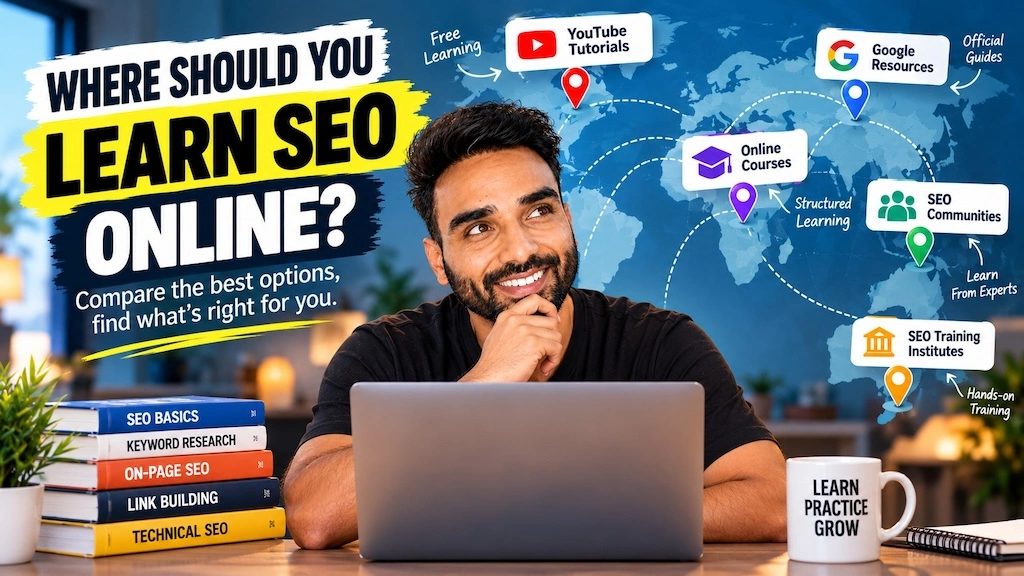
If you search for where to learn SEO, you’ll find 1,014 SEO courses on Class Central, 861 on Udemy, and one university program on Coursera that has more than 278,000 enrolled learners. That’s before you count Google’s own documentation, free tool academies, YouTube, Bangalore classroom institutes and private coaches. So the question is not where SEO is taught. It is taught almost everywhere. The question is which place will actually make you able to rank a website, and in 2026 that also means getting cited in ChatGPT, Perplexity and Google AI Overviews.
TL;DR
There are seven places to learn search engine optimisation: Google’s own documentation, free tool academies (Ahrefs, Semrush, HubSpot), online course platforms (Coursera, Udemy), YouTube and communities, live online cohorts, offline institutes, and one-on-one coaching. To learn SEO online, start free with Google and Ahrefs. Then move to a live program taught by someone who still works on client projects, because free and recorded material goes out of date fast and nobody checks your work. Students get the most from a live cohort with projects. Founders get the most from one-on-one training on their own website.
Where to learn SEO? The 7 places compared
You can learn SEO in seven kinds of places. Each one is good at something different, so most people who get good at SEO use two or three of them together.
| # | Where | Cost | What it gives you | What it misses |
|---|---|---|---|---|
| 1 | Google’s own documentation | Free | The rules, straight from the source | Strategy and priorities |
| 2 | Free tool academies (Ahrefs, Semrush, HubSpot) | Free | Clear basics and a free certificate | Feedback, and often up-to-date AI search content |
| 3 | Online course platforms (Coursera, Udemy) | ₹500 to ₹50,000 | Structure and a recognised certificate | Live help, and quality varies widely |
| 4 | YouTube, blogs and communities | Free | Fast answers to specific problems | Any learning order |
| 5 | Live online cohorts | ₹15,000 to ₹60,000 | Classes, assignments, feedback and peers | Flexibility on timing |
| 6 | Offline institutes | ₹15,000 to ₹60,000+ | Face-to-face teaching and a fixed routine | You must live near one |
| 7 | One-on-one coaching | From about ₹50,000 | Training built around your own site | Highest cost per hour |
In short: You can learn SEO from Google’s documentation, free tool academies, online course platforms, YouTube and communities, live online cohorts, offline institutes, or one-on-one coaching. Free sources teach the basics. Live and one-on-one formats add the feedback that builds real skill.
Where to learn SEO online?
The best places to learn SEO online are Google Search Central and the free tool academies for the basics, then a structured paid program for depth. Here is where I would send someone today.
Where can you learn SEO online for free?
| Platform | What to take | Time |
|---|---|---|
| Google Search Central | SEO Starter Guide | 1 to 2 hours |
| Ahrefs Academy | SEO Training and Certification, AEO course | About 3.5 hours |
| Semrush Academy | SEO fundamentals and keyword research courses | 1 to 7 hours each |
| HubSpot Academy | SEO Certification | About 4 hours |
| Moz Beginner’s Guide | The full reading guide | A weekend |
These are good starting points, but beginner material often lags behind Google’s updates and AI search. Use it to learn the terms, then practise. I compare them with paid options in my Google free SEO course alternatives guide.
Where can you learn SEO online with structure and feedback?
| Platform | Format | Price | Notes |
|---|---|---|---|
| Mohit’s SEO Training | Live online, 8 weeks, maximum 10 students | ₹15,000 | Real-site projects, AEO/GEO and building your own AI SEO agents |
| Coursera: UC Davis SEO Specialization | Self-paced, 5 courses, about 2 months | Coursera subscription | University certificate. My UC Davis review |
| WsCube Tech | Live online, 6 weeks, 60+ live hours | Check the course page | Evening batches |
| Udemy | Recorded | Often under ₹1,000 on sale | Quality varies. My Udemy review |
| Simplilearn | About 16 live plus 35 recorded hours | About $800 to $1,499 | Big-brand certificate. My Simplilearn review |
In short: To learn SEO online, start free with Google Search Central, Ahrefs, Semrush, HubSpot and Moz. Then choose a structured program such as Mohit’s SEO Training, UC Davis on Coursera or WsCube Tech, ideally a live one where someone reviews your work.
Should you learn SEO at an offline institute or in a live online class?
For most people, a live online class now gives you everything a classroom does, minus the commute. Offline institutes still suit learners who need a fixed physical routine. What matters in both cases is the trainer and the batch size, not the building.
| Factor | Offline institute | Live online cohort |
|---|---|---|
| Interaction | Face to face | Live video, chat and screen-share reviews |
| Recordings | Usually not | Usually yes, for revision |
| Batch size | Often 20 to 40 | Can be as small as 10 |
| Commute | Daily travel | None |
| Trainer | Limited to local trainers | Any practitioner, anywhere |
| Best for | Learners who need a physical routine | Students, working professionals and founders |
How do you judge any SEO institute, online or offline?
- Ask whether the trainer still does SEO for clients.
- Ask how many students are in a batch.
- Ask whether you will work on a real website every week.
- Check that the syllabus includes AI Overviews, AEO and GEO.
- Ask for specific placement or client outcomes, not “100% placement”.
If you’re comparing city options, I’ve reviewed institutes in my guides to SEO courses in Bangalore, Mumbai, Delhi and Kerala.
In short: Live online cohorts now match offline institutes on interaction, and add recordings, smaller batches and access to practising trainers. Judge any institute on its trainer, batch size, real-site practice and AI search coverage.
Where do you actually learn SEO by doing?
On a real website. Courses tell you what to do, but SEO skill comes from watching what happens after you change something. That’s why I call the practice site the most important “place” to learn SEO.
Where can you practise SEO for free?
- Your own practice site. A free WordPress or Blogger site, connected to Google Search Console and GA4. Publish, optimise and watch the data.
- A local business. Offer a free audit to a clinic, café or shop. Real sites have messy problems that course examples never show.
- Free tools. Screaming Frog (up to 500 URLs), Ahrefs Webmaster Tools, and my own free SEO tools, including a schema generator, robots.txt checker and SERP preview.
Where do SEOs keep learning after a course?
- Google’s own channels: the Search Central blog and Google’s ranking update announcements.
- Communities: SEO groups on LinkedIn, Reddit and X, where practitioners share what is working right now.
- Internships and agencies: a few months at an agency teaches client communication and reporting that no course covers.
- Algorithm update recaps: I track the important ones in Google SEO updates.
In short: You learn SEO by doing it on a practice site or a real local business, using free tools. You keep learning through Google’s official channels, SEO communities, internships and algorithm update recaps.
Who can do an SEO course?
Anyone who can use a computer and write clear English can do an SEO course. There is no degree, coding or age requirement. What you need is curiosity about how people search, and 5 to 7 hours a week to practise. In my batches I see people from very different backgrounds, and the ones who do best are not the most technical. They are the ones who practise every week.
| Who | Why SEO fits | What to focus on |
|---|---|---|
| Students and fresh graduates (any stream) | One of the few marketing skills you can prove with results before your first job | Technical SEO, tools, a portfolio and interview practice |
| Working professionals in marketing, content or sales | Adds a high-demand skill to your current role | Technical SEO, AEO/GEO and reporting |
| Content writers and bloggers | SEO is what makes writing get found | Keyword research, intent and on-page SEO |
| Web developers and designers | Most SEO problems start in how a site is built | Technical SEO, Core Web Vitals and schema. See why developers use SEO |
| Founders and small business owners | Search and AI answers bring customers without paying per click | Strategy, local SEO and judging agencies |
| Freelancers and career switchers | Low setup cost and remote client work | Audits, client reporting and AI workflows |
| Homemakers and people returning to work | Flexible, home-based work once you are skilled | A practice site and freelance-ready skills |
Do you need any qualification to do an SEO course?
No. Commerce, arts, science and engineering graduates all do well, and so do people without a degree. Basic comfort with Google Docs, spreadsheets and WordPress helps, and you pick up simple HTML along the way. If you can read Google’s SEO Starter Guide and follow it, you can do an SEO course.
Who should not do an SEO course yet?
Anyone expecting quick results. SEO pays off over months, not days. If you can’t give it a few hours every week for at least two to three months, start with the free resources and come back to a paid course when you have the time.
In short: Anyone can do an SEO course: students from any stream, working professionals, writers, developers, founders, freelancers and people returning to work. You need no qualification, just basic computer skills, curiosity and a few hours of practice each week.
Where should students and founders learn SEO?
Students should learn SEO in a live cohort that ends with a portfolio. Founders should learn it on their own website, ideally one-on-one. The “where” follows from what you need SEO to do for you.
| Students and freshers | Founders | |
|---|---|---|
| Start with | Google Search Central and Ahrefs Academy | Google Search Central, then your own Search Console data |
| Then learn at | A live online cohort with projects and mock interviews | A one-on-one SEO program built around your site |
| Practise on | A practice site and free audits for local businesses | Your own business website |
| Avoid | Collecting free certificates as your only proof | Hiring an agency before you understand the basics |
| Proof it worked | 2 to 3 audits and a ranked practice site | More enquiries from Google and AI search |
Students can preview the week-by-week path in how to learn SEO step by step. Founders can start with whether SEO is worth it for a small business.
In short: Students should start free, then join a live cohort and build a portfolio. Founders should start with their own Search Console data, then learn one-on-one on their own website.
FAQs
What is the best place to learn SEO for free?
Google Search Central’s SEO Starter Guide, followed by Ahrefs Academy. Google tells you what it wants, and Ahrefs shows you how to do it with tools. A student who reads Google’s guide before an interview usually explains crawling and indexing far more accurately than one who only watched videos.
Can I learn SEO online and still get a job?
Yes. Employers don’t care where you learned, only what you can show. An online learner with two written-up audits and a practice site that ranks will beat an offline learner with only a certificate.
Is YouTube a good place to learn SEO?
For single topics, yes. For learning SEO as a whole, no. YouTube is great for “how do I submit a sitemap” but gives you no learning order and nobody checks your work. Most YouTube-only learners I meet know many tactics but can’t put them into a plan.
How long does it take to learn SEO online?
About 2 to 3 months to become job-ready at 5 to 7 hours a week, and 6 to 12 months of real-site practice to become genuinely good.
Where can I test my SEO knowledge?
Take my free Advanced SEO Quiz. It has 50 questions covering on-page, technical, AEO/GEO, GA4 and Search Console, and scores you at the end.
In short: Start free with Google and Ahrefs. Online learning can get you hired if you build proof. YouTube is for single topics, job-readiness takes 2 to 3 months, and a free quiz shows where you stand.
So, where should you learn SEO?
Learn the basics free from Google and the tool academies, practise on a real website from week one, and then learn from a person rather than a playlist. If you are serious about learning SEO and actually executing it, choose a live program taught by someone who still works on client projects. Recorded and free material goes out of date quickly, especially with AI search changing every few months, and only a practising trainer can tell you what is working right now.
You can see what that looks like in the Advanced Online SEO Training curriculum, or contact me with your goal and I’ll point you to the right place to start.
In short: Start free, practise on a real site, and learn from a live, practising SEO trainer if you’re serious about results.
Sources
I checked these pages in October 2026:
- Class Central SEO courses: 1,014 SEO courses.
- Udemy SEO topic: 861 SEO courses.
- UC Davis SEO Specialization on Coursera: 278,301 enrolled, about 2 months.
- Ahrefs Academy: free SEO and AEO courses.
- Swydo SEO certification guide: lengths of the Ahrefs and HubSpot courses.
- WsCube Tech online SEO course: 6-week live format.
Disclaimer
I run Mohit’s SEO Training, which is listed among the options above, so please weigh my view with that in mind. Course details and prices for other providers come from their public pages and third-party guides as of October 2026 and may change, so confirm them before you enrol. No course or platform guarantees a job, ranking or business result.

mohitverma
Mohit Verma is the founder and lead trainer of Mohit’s SEO Training, a Bangalore-based AI SEO training institute. With 12+ years of hands-on SEO experience, he has trained 500+ learners since 2022 and also runs the SEO agency Road To Top 5. Connect with him on LinkedIn or YouTube.