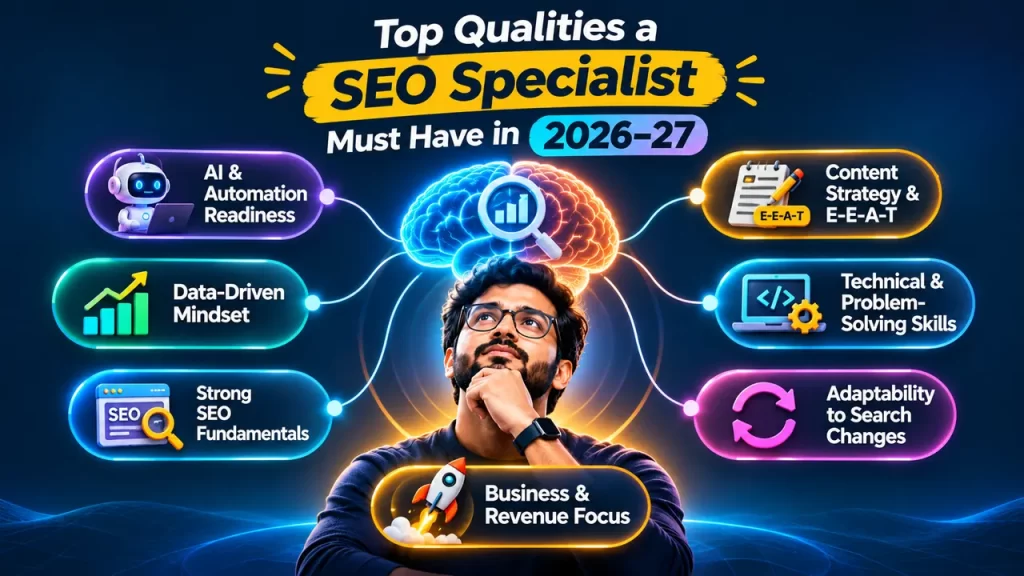
Being an SEO expert in 2026 is a very different job from even two years ago. During Google’s March 2026 core update, 79.5% of the URLs in the top 3 results changed position. At the same time, 68% of Google searches ended without a click, and AI tools started sending visitors from more and more places. So knowing the right tags and tools isn’t enough anymore. In my 12+ years of SEO consulting and training, the experts who keep winning are the ones with the right qualities: they stay calm when rankings swing, they understand the business, they use AI without trusting it blindly, and they can explain all of it in plain words. An SEO expert in 2026-27 is defined less by the tactics they know and more by the qualities that help them adapt, decide and deliver real business results while search keeps changing.
TLDR
A good SEO expert in 2026-27 needs more than technical knowledge. Search now changes fast: core updates shake up rankings, AI Overviews and AI Mode answer questions without a click, scaled AI content gets penalised, and visitors arrive from Google, ChatGPT, Gemini and other places. To handle all of that, an SEO expert needs 15 key qualities. They include curiosity, calm and evidence-based thinking, business sense, good judgement about priorities, real empathy for the searcher, technical depth, smart and careful use of AI, strong ethics, editorial standards, brand thinking, a multi-platform mindset, measurement beyond clicks, clear communication, the ability to influence people, and patience. Each quality below is tied to a real problem SEO experts face today, with simple ways to build it.
What does an SEO expert have to deal with in 2026-27?
Before we look at the qualities, it helps to see the problems they need to solve. Here are the biggest SEO challenges right now, with the latest data behind each one.
| Modern SEO challenge | What’s happening | The quality it demands |
|---|---|---|
| Wild ranking swings | In the March 2026 core update, 79.5% of top-3 URLs changed position, and the May 2026 core update caused heavy movement again | Calm, evidence-based thinking and patience |
| Fewer clicks | 68% of Google searches ended with no click in early 2026, and clicks drop by nearly 60% when an AI Overview appears | Business sense and measurement beyond clicks |
| AI answers everywhere | AI Mode alone cut clicks to websites by 18.8 percentage points in a study of 1,100 users | Brand thinking and AI fluency |
| A crackdown on mass-produced content | Google’s August 2026 spam update hit scaled AI content, thin affiliates and programmatic pages, and Google’s Gary Illyes says scaled content is becoming a bigger problem than link spam | Ethics and editorial standards |
| Traffic coming from more places | Google still holds 89.9% of global search (StatCounter, September 2026), but AI referrals are splitting: ChatGPT fell below 77% and Gemini reached 9% of AI chatbot referrals by April 2026 | A multi-platform mindset |
| Search is still the big channel | Across 118,671 sites, search brought 27.55% of traffic, while AI assistants brought 0.46% (Ahrefs, June 2025 to October 2026) | Good judgement, not hype |
| New searches every day | 15% of daily searches are completely new | Curiosity and empathy for the searcher |
| Mobile and speed | Mobile makes up 59% of global web traffic | Technical depth |
| Teams expect more than SEO | Communication is the top skill in non-senior SEO job listings at 39.4%, and 34% of SEO job descriptions now ask for AI search skills | Communication and influence |
What’s the big takeaway?
The tactics change every few months, but the problems above all reward the same kind of person: someone who thinks clearly, puts the business first, uses AI wisely and plays by the rules. That’s why I’m focusing on qualities, not just a list of tools.
In short: In 2026-27, SEO experts face huge ranking swings, fewer clicks, AI answers, a crackdown on scaled content and traffic from many places. Google is still the biggest channel by far, so good experts adapt without panicking or chasing hype.
What are the 15 qualities of an SEO expert?
Here’s the full list at a glance, followed by a closer look at each one: why it matters right now, what it looks like in real work and how you can build it.
| # | Quality | The modern problem it solves |
|---|---|---|
| 1 | Curiosity | Search changes every few months |
| 2 | Calm, evidence-based thinking | Big ranking swings during core updates |
| 3 | Business sense | Fewer clicks, so traffic alone means less |
| 4 | Good judgement about priorities | AI makes routine work cheap, so decisions matter more |
| 5 | Empathy for the searcher | AI answers the easy questions; people want depth |
| 6 | Technical depth | JavaScript sites, speed, AI crawlers |
| 7 | Smart, careful use of AI | AI is fast but can be confidently wrong |
| 8 | Ethics and integrity | Penalties for scaled and manipulative content |
| 9 | Editorial standards | Google rewards real, reviewed content |
| 10 | Brand thinking | AI answers mention trusted brands |
| 11 | A multi-platform mindset | Visitors come from Google, AI tools, YouTube and more |
| 12 | Measuring beyond clicks | Value shows up in leads, mentions and brand searches |
| 13 | Clear communication | Results must make sense to non-SEO people |
| 14 | Influence and teamwork | SEO fixes need developers, writers and managers |
| 15 | Patience and resilience | Results take months, and updates can set you back |
1. Why does curiosity matter so much for an SEO expert?
Because search keeps changing. Google says 15% of daily searches are completely new, new AI features launch every few months, and what worked last year can stop working. A curious SEO expert wants to know why something happened, not just what happened.
What it looks like: When a new feature like AI Mode appears, they try it, read Google’s documentation and check how it affects their own sites, instead of waiting for someone to write a summary.
How to build it: Follow Google Search Central and one or two trusted news sites, and run small experiments on your own website every month.
2. Why is calm, evidence-based thinking important?
Because rankings now swing harder than ever. In the March 2026 core update, 79.5% of top-3 URLs changed position, and a spam update landed just days before it, so many sites couldn’t tell which one hit them. An expert doesn’t panic or guess. They check the data first.
What it looks like: When traffic drops, they confirm the data is right, find which pages and queries dropped, compare dates with Google’s update history and only then decide what to change.
How to build it: Practise diagnosing drops with real Search Console data. A useful habit is to write down your idea of the cause before you look at the data, then test it.
3. Why does an SEO expert need business sense?
Because traffic isn’t the goal; customers are. With 68% of Google searches ending without a click, an SEO expert who only reports traffic will struggle. The best experts know which pages make money and focus their effort there.
What it looks like: Instead of chasing a high-volume blog keyword, they improve a pricing or service page that brings leads, and they report results as enquiries, sales or revenue.
How to build it: For every project, ask: “How does this business make money, and which searches lead to that?” Learn to read basic numbers like conversion rate and lead value.
4. Why is good judgement about priorities so valuable now?
Because AI can now produce audits, keyword lists and briefs in minutes. As hiring expert Nick LeRoy put it in Search Engine Land, the real value is now in deciding which recommendations actually matter. A site might have 200 issues, but only five that truly affect results.
What it looks like: They fix the noindex tag blocking key pages before worrying about missing alt text, and they can explain why in one sentence.
How to build it: For every list of issues, sort them by impact and effort before doing anything. Ask yourself, “If I could only fix three things, which three?”
5. Why does empathy for the searcher matter?
Because AI Overviews now answer many simple questions directly on Google. People who still click usually want more depth, more detail or a real opinion. An SEO expert who truly understands what the searcher wants creates content AI can’t easily replace.
What it looks like: Before writing, they read the results page, the “People also ask” questions and real customer questions, then build a page that solves the whole problem, not just the keyword.
How to build it: Talk to real customers or sales teams, and read forums like Reddit and Quora in your niche. Google’s guide to helpful, people-first content is a great checklist.
6. Why does an SEO expert still need technical depth?
Because a page can’t rank if Google can’t crawl, render and understand it. Many modern sites use JavaScript, mobile makes up 59% of global web traffic, and AI crawlers now visit sites too. Technical problems are often invisible until traffic drops.
What it looks like: They can spot a staging noindex left on after launch, check how Google renders a JavaScript page, improve INP and decide which AI crawlers to allow in robots.txt.
How to build it: Learn to use Search Console’s URL Inspection, a crawler like Screaming Frog and PageSpeed Insights. Practise with free tools like a robots.txt checker and a schema markup generator.
7. Why is smart, careful use of AI a must?
Because AI saves a lot of time, but it can also be confidently wrong. A modern SEO expert uses AI to work faster while checking everything it produces, especially facts, technical code and anything that goes live.
What it looks like: They use AI to group keywords, draft briefs and summarise data, then check the facts, fix the intent and add real experience before anything is published.
How to build it: Use AI on a real task every week and keep a note of the mistakes you catch. That list becomes your personal checklist. For AI search itself, my guide on how to rank in ChatGPT and Perplexity is a good start.
8. Why do ethics and integrity matter more than ever?
Because Google is cracking down hard on shortcuts. Its spam policies cover scaled content abuse, site reputation abuse and expired domain abuse, and the August 2026 spam update hit sites built on mass-produced and programmatic content. One risky tactic can wipe out years of work for a client.
What it looks like: They refuse to buy links, mass-publish unreviewed AI content or promise guaranteed rankings, and they explain the risks honestly when a client asks for shortcuts.
How to build it: Read Google’s spam policies once a year, and ask one simple question before any tactic: “Would I be comfortable explaining this to Google?”
9. Why are editorial standards part of an SEO expert’s job?
Because Google’s quality guidelines now specifically flag AI content published without human review, and pages need real experience, accuracy and trust to rank. An SEO expert doesn’t just pick keywords. They make sure every page is genuinely good.
What it looks like: They check facts, add author details, first-hand examples and sources, and they’d rather publish 10 strong pages than 100 thin ones.
How to build it: Create a simple checklist for every page before it goes live: is it accurate, is it useful, does it show real experience, and would I share it with a friend?
10. Why does an SEO expert need to think about the brand?
Because AI answers tend to mention brands that are trusted and talked about across the web. Google’s direction is also clear: a site’s reputation should exist beyond its own pages. A strong brand gets more branded searches, more mentions and more trust from both people and AI tools.
What it looks like: They make sure the brand is described the same way everywhere, earn mentions in news and industry sites through digital PR, collect genuine reviews and build real author profiles.
How to build it: Search for your brand in Google, ChatGPT and Perplexity, and note what they say. Then work on the gaps, like missing reviews or wrong information.
11. Why is a multi-platform mindset important?
Because visitors now arrive from more places. Google still leads with 89.9% of global search, but AI referrals are spreading out: ChatGPT’s share fell below 77% while Gemini reached 9% by April 2026. YouTube, Reddit and Google Business Profile also shape what people find.
What it looks like: They keep Google as the main focus, because it’s still the biggest channel by far, while making sure the brand shows up well in AI tools, video results and local results too.
How to build it: Check your GA4 referral data every month to see which platforms send visitors, and learn the basics of YouTube SEO and local SEO. My local SEO course is one way to start.
12. Why must an SEO expert measure beyond clicks?
Because clicks no longer tell the whole story. When an AI Overview answers a question, people may never visit your site, yet they still see your brand. A modern SEO expert tracks leads and sales from search, branded search growth, AI mentions and visibility, not just traffic.
What it looks like: Their reports show enquiries and revenue from organic search first, then supporting signals like impressions, branded searches and how often the brand appears in AI answers.
How to build it: Learn GA4 key events and Search Console well, and set up a simple monthly check of 20 important questions in AI tools to track whether your brand appears.
13. Why is clear communication so important?
Because SEO only matters if people understand it. In Semrush’s study of SEO job listings, communication was the most requested skill for non-senior roles, at 39.4%. An SEO expert has to explain complex ideas to business owners, developers and writers in simple words.
What it looks like: Instead of “We fixed canonicalisation issues”, they say, “Google was confused about which version of our pricing page to show. We fixed it, and leads from that page are up 20%.”
How to build it: Practise explaining one SEO idea a week in a short LinkedIn post or to a friend who doesn’t work in marketing. If they understand it, you’ve explained it well.
14. Why do influence and teamwork matter for SEO?
Because most SEO fixes need someone else to make them happen. Developers change the code, writers create the content and managers approve the budget. An SEO expert who can’t get others on board will have great ideas that never go live.
What it looks like: They write clear tickets with the business impact, offer a small first step when a big fix gets stuck, and share credit when results come in.
How to build it: Next time you recommend something, include three things: what’s wrong, why it matters in money or leads, and the smallest step to fix it.
15. Why are patience and resilience essential?
Because SEO takes time, and setbacks happen. New pages can take months to rank, core updates can move results overnight, and recovery after an update often only shows at a later one. An SEO expert stays steady, keeps clients informed and keeps improving.
What it looks like: After a drop, they don’t make 20 panic changes. They study what happened, make careful improvements and set clear expectations about timelines.
How to build it: Keep a simple log of changes and results for each site. Over time, it shows you that steady work pays off, which makes patience much easier.
In short: The 15 qualities are curiosity, calm thinking, business sense, good judgement, empathy for the searcher, technical depth, careful use of AI, ethics, editorial standards, brand thinking, a multi-platform mindset, measuring beyond clicks, clear communication, influence and patience. Each one solves a real SEO problem in 2026-27, and each can be learned with practice.
How can you tell a real SEO expert from a pretender?
Look at how they talk about results, risks and AI. Anyone can call themselves an SEO expert, so whether you’re hiring someone or checking your own progress, these signs make it easy to spot the difference.
| What to check | A real SEO expert | A pretender |
|---|---|---|
| Promises | Gives realistic timelines and milestones | Guarantees first place in 30 days |
| Results | Shares case studies with leads, sales or revenue | Talks only about rankings and traffic |
| AI | Uses AI with checks and explains its limits | Says AI will do everything, or that SEO is dead |
| Tactics | Follows Google’s guidelines and explains the risks | Offers cheap link packages or mass-produced content |
| Updates | Explains what changed and checks the data first | Blames every drop on “the algorithm” |
| Communication | Explains things in plain words | Hides behind jargon |
| Questions they ask you | Asks how your business makes money | Jumps straight into keywords |
Which questions help you test an SEO expert?
Try these three: “What would you check first if our traffic dropped 30%?”, “How do AI Overviews affect a business like ours?” and “Tell me about a time something you tried didn’t work.” A real expert answers calmly, with a clear method and an honest example. If you’re preparing for interviews yourself, the SEO interview guides go much deeper.
In short: Real SEO experts set realistic expectations, show business results, use AI carefully, follow Google’s rules and explain things simply. Pretenders guarantee rankings, talk only about traffic and blame the algorithm.
How can you build these qualities?
By doing real work, not just reading about it. Most of these qualities grow fastest when you work on a live website, make decisions, see what happens and learn from it. Here’s a simple path I suggest to my students.
| Stage | What to focus on | Qualities you build |
|---|---|---|
| Month 1 to 2 | Learn how search works, set up Search Console and GA4, and start your own small website | Curiosity, technical depth |
| Month 3 to 4 | Research what your audience searches for, write helpful pages, and check them before publishing | Empathy for the searcher, editorial standards, ethics |
| Month 5 to 6 | Read your data every week, diagnose any drops, and try one small test | Calm thinking, measuring beyond clicks, patience |
| Month 7 onwards | Work on a real business site, report in business terms and work with others | Business sense, judgement, communication, influence |
| All the time | Use AI on real tasks, check its work, and track how your brand appears across platforms | Careful use of AI, brand thinking, a multi-platform mindset |
Do you need years of experience to have these qualities?
No. Experience helps, but these qualities come from how you work, not how long you’ve worked. A student who runs a small site for six months, tracks results honestly and learns from mistakes can show more of these qualities than someone with five years of copy-paste work.
Which quality should you start with?
Start with curiosity and calm, evidence-based thinking. They make every other quality easier to learn. A quick way to check where you stand is the free advanced SEO quiz.
In short: You build these qualities by working on real websites, making decisions and learning from results. Experience helps, but how you work matters more than how long. Start with curiosity and calm thinking.
How can Mohit’s SEO Training help you become an SEO expert?
In my training, you work on live websites from the start, so you build these qualities by doing, not just reading. You’ll diagnose real problems, use AI with proper checks, report results in business terms and learn how search is changing in 2026-27.
| If you want | Start here |
|---|---|
| A complete path from basics to advanced, on live projects | Advanced online SEO training |
| Personal guidance on the qualities you want to build | One-on-one SEO training |
| Local SEO skills for businesses and agencies | Local SEO course |
| A look at everything on offer | All SEO courses |
In short: Learning on live websites is the fastest way to build the qualities of an SEO expert. Choose the advanced course for the full path, one-on-one training for personal guidance or the local SEO course for local businesses.
Frequently asked questions
What are the most important qualities of an SEO expert?
The most important ones are curiosity, calm and evidence-based thinking, business sense and good judgement about priorities, because they help with every other part of SEO. For example, when a core update hits, a curious, calm expert checks the data and finds that only one section of the site dropped, instead of panicking and changing the whole site.
Is technical knowledge enough to be a good SEO expert?
No. Technical knowledge is important, but on its own it isn’t enough in 2026. For example, an SEO who fixes every technical issue but can’t explain the impact to the business owner, or can’t get developers to act, will see little real progress.
What skills does an SEO expert need for AI search?
An SEO expert needs to understand how AI Overviews, AI Mode and tools like ChatGPT choose sources, and how to build a trusted brand that gets mentioned. For example, they might notice that ChatGPT describes a client’s product wrongly, then fix it by updating the website, profiles and reviews so the information is clear and consistent everywhere.
How can a business tell if an SEO expert is good?
Check whether they show real business results, set realistic timelines and explain things simply. For example, ask them what they’d check first if your traffic dropped by 30%. A good expert will describe a clear step-by-step method, while a weak one will blame “the algorithm” or promise a quick fix.
Can a beginner develop the qualities of an SEO expert?
Yes. These qualities come from how you work, not just how long you’ve worked. For example, a beginner who runs a small blog for six months, studies their Search Console data every week and learns from a failed test is already building curiosity, calm thinking and patience.
Sources
- Search Engine Land: March 2026 Google core update, what changed
- GSQi (Glenn Gabe): May 2026 core update analysis
- GSQi (Glenn Gabe): August 2026 spam update case studies
- Search Engine Journal: The next massive Google update is around the corner
- Search Engine Land: Google zero-click searches 2026 study (SparkToro)
- Let’s Data Science: Study finds Google AI search reduces referrals
- Statcounter: ChatGPT falls to all-time low as AI chatbot referral market fragments
- Ahrefs: AI vs search traffic benchmarks
- Colorlib: Search statistics 2026 (StatCounter and Google data)
- Semrush: What 3,900 SEO job listings reveal
- Omniscient Digital: How SEO roles are changing with AI search
- Search Engine Land: Interviewing SEOs in an AI-first world
- Google Search Central: Spam policies
- Google Search Central: Creating helpful, people-first content

mohitverma
Mohit Verma is the founder and lead trainer of Mohit’s SEO Training, a Bangalore-based AI SEO training institute. With 12+ years of hands-on SEO experience, he has trained 500+ learners since 2022 and also runs the SEO agency Road To Top 5. Connect with him on LinkedIn or YouTube.