

One student shows me a ₹15,000 offer letter. The next shows me a LinkedIn post about an SEO earning ₹2 lakh a month. Both are real, and that confusion stops many people from choosing SEO. The numbers explain the gap. Hyring’s 2026 India salary model puts the median SEO executive salary at ₹3.9 lakh a year, with freshers between ₹1.8 lakh and ₹2.5 lakh. In the United States, Indeed reports an average SEO specialist salary of about $71,000 a year, and experienced freelance SEO experts charge $60 to $110 an hour. There is no single SEO salary. In India, SEO job titles are mixed up: a 2-year SEO can be a manager at a small company and an executive at a big one. So your pay depends less on your title and more on what you can prove and how well you sell yourself. Salary is no bar for the right candidate: companies and foreign clients stretch their budgets for SEOs who bring results, and those who specialise, add AI skills and serve global clients earn many times the average.
TL;DR
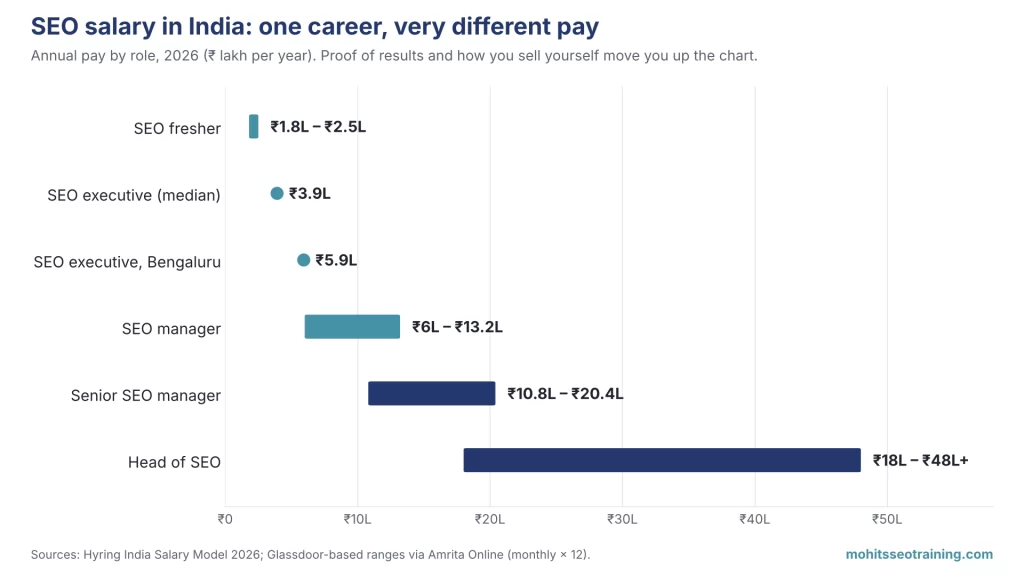
In India, SEO freshers usually earn ₹12,000 to ₹28,000 a month, the median SEO executive earns about ₹3.9 lakh a year, SEO managers earn about ₹50,000 to ₹1.1 lakh a month, and heads of SEO can earn ₹1.5 lakh to ₹4 lakh or more a month. Bengaluru pays the highest among Indian cities. Job titles in India are inconsistent: a 2-year SEO can be an “SEO manager” at a small company and an “SEO executive” at a large one, so compare responsibilities, not titles. Your salary depends heavily on how well you sell your skills and results. Globally, US SEO specialists average roughly $70,000 to $86,000 a year depending on the source. Bands describe the average, not the ceiling. The right candidate, one who shows proof of results, AI search skills and business thinking, gets offers above the band. The fastest way to raise income is to work with foreign clients, where experienced SEO freelancers bill in dollars and monthly retainers commonly run $1,500 to $4,000.
What is the SEO salary in India in 2026?
SEO salary in India depends on role, experience, city, company type and skill depth. Here are the ranges I use when students ask me what to expect.
SEO salary in India by role (monthly)
| Role | Typical experience | Monthly salary range |
|---|---|---|
| SEO trainee or executive | 0 to 2 years | ₹12,000 to ₹28,000 |
| SEO analyst | 1 to 3 years | ₹20,000 to ₹45,000 |
| SEO specialist | 2 to 5 years | ₹30,000 to ₹60,000 |
| SEO manager | 4 to 8 years | ₹50,000 to ₹1,10,000 |
| Senior SEO manager | 6 to 10 years | ₹90,000 to ₹1,70,000 |
| Head of SEO or SEO director | 10+ years | ₹1,50,000 to ₹4,00,000+ |
Salary ranges come from Glassdoor-based data compiled by Amrita Online. Experience bands are typical, not fixed rules, and titles vary widely between companies, as the next section explains.
SEO executive salary in India by level (annual)
| Level | Annual CTC range |
|---|---|
| Fresher | ₹1.8 lakh to ₹2.5 lakh |
| Intermediate | ₹2.5 lakh to ₹6.4 lakh |
| Senior | ₹6.4 lakh to ₹9.2 lakh |
Source: Hyring India Salary Model 2026.
In short: In 2026 SEO salaries in India range from about ₹12,000 a month for trainees to ₹4 lakh or more a month for heads of SEO. The median SEO executive earns about ₹3.9 lakh a year, and pay rises sharply once you move into specialist and manager roles.
Why are SEO job titles and salaries so confusing in India?
SEO job titles in India do not follow a standard. Every company names roles based on its own size and structure, so the same title can mean very different work and very different pay. This is the reason two people with the same experience can earn completely different salaries.
The same experience, two different titles
Take two SEO professionals, each with two years of experience.
| Factor | SEO “manager” at a small company | SEO “executive” at a large company |
|---|---|---|
| Experience | 2 years | 2 years |
| Team | Works alone or leads one or two juniors | Part of a team with a head of SEO, content and developers |
| Scope | Does everything: audits, content, links, reporting, client calls | Owns one area, such as technical SEO or a product category |
| Website scale | One or a few small sites | Large sites with thousands of pages and real revenue at stake |
| Learning | Broad but shallow, little mentoring | Deep in one area, strong mentoring and processes |
| Salary logic | Title is senior, but budget is limited | Title is junior, but company budget and pay bands are higher |
In my experience, the big-company executive often earns the same as or more than the small-company manager, even though the title looks lower. And when the small-company manager applies to a large company, recruiters often offer an executive or specialist title, because they judge the scope of work, not the title.
Why Indian companies label SEO roles so differently
- Small companies and startups give senior titles to attract talent they cannot pay much.
- Agencies use “manager” for anyone who handles client accounts.
- Large companies keep strict levels, so even strong performers stay “executive” or “specialist” for a while.
- Many companies merge SEO with content, social media or performance marketing, which blurs the role further.
How to read an SEO job title before you accept an offer
Ignore the title for a moment and ask four questions. What will I own? How big are the websites? Who will I learn from? How is success measured? The answers tell you the real level of the role and whether the salary is fair for it.
In short: SEO job titles in India are not standardised, so a 2-year SEO can be a manager at a small company and an executive at a large one. Salaries follow company size, scope and budget more than titles, so always judge a role by what you will own, the scale of the websites, the mentoring and how success is measured.
How does selling yourself decide your SEO salary?
Because titles are so inconsistent, recruiters and clients cannot rely on them to judge you. They rely on how clearly you present your skills and results. Two SEOs with identical work can receive very different offers simply because one explains their impact well and the other lists tasks. In India’s SEO market, your salary depends heavily on how good you are at selling yourself.
Step 1: Describe scope, not title
Write “Owned technical SEO for a 12,000-page ecommerce site” instead of “SEO Executive”. Scope tells a recruiter your real level instantly.
Step 2: Put numbers on every result
Show traffic growth, leads, revenue, indexing fixes and ranking recoveries with before-and-after figures. Numbers turn a vague role into a clear value.
Step 3: Build a one-page portfolio
Collect two or three case studies with Search Console screenshots, audits and outcomes. A portfolio sells you even before the interview starts.
Step 4: Position yourself by specialisation
Use a LinkedIn headline such as “Technical SEO for SaaS” or “Local SEO for clinics” rather than a generic title. Specialists get approached with better offers.
Step 5: Tell your story well in interviews
Explain one problem you found, what you did and what changed. A clear 2-minute story convinces interviewers more than a list of tools.
Step 6: Negotiate on the market value of your scope
Compare your responsibilities with the salary bands for that scope, not for your current title. If you already do specialist or manager-level work, negotiate for that level.
Step 7: Choose growth over a bigger title
A “manager” title at a small company looks good, but an “executive” role at a strong company can teach you more and lead to higher pay within a few years. Pick the role that grows your skills and your story.
In short: Because SEO titles in India are inconsistent, your salary depends heavily on how well you sell yourself. Describe your scope, quantify results, keep a portfolio, position yourself by specialisation, tell clear interview stories, negotiate on the value of your scope and choose growth over titles.
What is the SEO salary per month for freshers?
Most SEO freshers in India earn ₹12,000 to ₹25,000 a month in their first role. Three things decide where you land in that band.
Proof of work
A fresher who shows a live website with growing Search Console impressions, a technical audit and a written case study gets the upper end. A fresher with only a certificate gets the lower end.
Type of employer
Small local agencies usually pay the least. Product companies, SaaS startups, D2C brands and agencies with foreign clients usually pay more because organic growth earns them more.
City and work mode
Metro cities pay more, and remote roles with Bengaluru or overseas companies let freshers in smaller cities earn metro-level salaries.
In short: SEO freshers in India usually earn ₹12,000 to ₹25,000 a month. Proof of work, the type of employer and the city or remote setup decide whether an offer lands at the lower or upper end.
What is the SEO salary in Bangalore and other cities?
| City | Estimated SEO executive salary (annual) |
|---|---|
| Bengaluru | About ₹5.9 lakh (mean) |
| Hyderabad | About ₹5.3 lakh |
| Gurugram | About ₹4.7 lakh (median) |
| India overall | About ₹3.9 lakh (median) |
Source: Hyring city salary estimates. Bengaluru leads because SaaS companies, startups and global capability centres hire SEO talent for growth roles there. I train students in Bengaluru, and the best-paying offers I see come from companies that sell to global customers.
In short: Bengaluru pays the highest SEO executive salaries in India at about ₹5.9 lakh a year on average, followed by Hyderabad and Gurugram. Companies selling to global customers pay the most.
What is the SEO salary globally?
When people search “what is SEO salary”, many want to compare India with international markets. The United States offers the clearest data.
| Source | US SEO specialist pay |
|---|---|
| Indeed | About $71,000 average base salary |
| Glassdoor (via GTM 80/20) | About $86,000 average; entry level about $58,860; senior about $104,103 |
| Levels.fyi | About $90,000 median total compensation |
You do not need to move abroad to tap into these markets. Many Indian SEO professionals earn from US, UK, Australian and Middle Eastern companies through remote jobs and freelance contracts.
In short: US SEO specialists earn roughly $71,000 to $90,000 a year depending on the data source, with senior specialists above $100,000. Indian SEOs can access part of this market through remote work and foreign clients.
Why is salary no bar for the right SEO candidate?
Salary bands describe what an average candidate gets, not what the right candidate gets. I have seen companies stretch budgets, create new titles and add incentives when they find someone who can clearly move their numbers. The hiring data explains why. 74% of recruiters in India say qualified candidates have become harder to find, and a Semrush study of 3,900 SEO job listings found AI skills mentioned in 31% of senior listings. Employers have plenty of applicants but very few who match the modern skill set.
What makes someone the right candidate
- Shows results in numbers: traffic, leads, revenue, recovered rankings.
- Understands technical SEO deeply enough to diagnose problems alone.
- Knows AI search visibility: AI Overviews, ChatGPT and Perplexity citations, GEO and AEO.
- Uses AI agents and automation to deliver more in less time.
- Speaks in business language to founders and managers.
In short: Salary is no bar for the right SEO candidate because companies struggle to find people who combine proven results, technical depth, AI search skills, automation and business communication. Candidates who show these get offers above the standard band.
How do you use your SEO career smartly to earn more?
Two people can start SEO on the same day and earn very different amounts five years later. The difference is how smartly they use their career.
Choose your first job for learning, not salary
Pick the role where you will touch real websites, Search Console data and client problems. A ₹3,000 higher offer in a job where you only build directory links costs you lakhs later.
Specialise within two years
Pick technical, ecommerce, international, local or B2B SaaS SEO and go deep. Specialists compete with few people. Generalists compete with everyone.
Build public proof
Publish case studies, share audits on LinkedIn and build small free tools. Recruiters and clients start approaching you, which gives you negotiating power.
Negotiate with numbers
Walk into every appraisal or interview with a one-page summary of results you delivered. Numbers move salary conversations faster than years of experience.
Switch at the right time
Move when your learning slows down or when a company in a higher-value industry wants your specialisation. Smart switches often bring bigger raises than yearly increments.
Add a second income stream
Once you are confident, take one freelance project or a foreign client alongside your job, if your employment contract allows it. This builds income, confidence and a global portfolio.
In short: Use your SEO career smartly by choosing your first job for learning, specialising within two years, building public proof, negotiating with numbers, switching at the right time and adding a second income stream such as foreign clients.
How can foreign clients help you earn faster and more?
Working with foreign clients is the fastest way for an Indian SEO professional to raise income, because you earn in dollars, pounds or euros while living with Indian costs. Even at $25 an hour, a full working week can earn more than many fresher SEOs make in a month.
What foreign clients pay for SEO
| Level | Typical freelance rate |
|---|---|
| Junior SEO freelancer | Around $20 an hour |
| Experienced SEO freelancer | $60 to $110 an hour |
| Senior SEO expert | $80 to $140 an hour |
| Monthly retainer, mid-level | $1,500 to $4,000 for 15 to 25 hours of work |
Hourly ranges come from goLance’s 2026 SEO rate guide. Retainer ranges come from AiProposer’s Upwork analysis. Platforms such as Upwork charge freelancers a service fee, typically around 10%, so price your work accordingly.
How to land your first foreign client
- Pick one niche, such as SaaS, local service businesses in the US, or Shopify stores.
- Build two or three case studies with screenshots and numbers.
- Create a focused profile on Upwork and LinkedIn that speaks to that niche.
- Offer a paid audit first, then convert it into a monthly retainer.
- Overlap a few working hours with your client’s time zone and report results every month.
What to watch out for
Avoid underpricing just to win projects, because low prices attract difficult clients. Use written scopes, collect payments through reliable channels, and speak to a chartered accountant about invoicing and taxes on export of services. If you want to understand how global SEO projects work, my international SEO services page shows what multi-country clients usually need.
In short: Foreign clients help Indian SEOs earn faster because they pay in foreign currency. Experienced SEO freelancers commonly charge $60 to $110 an hour and mid-level retainers run $1,500 to $4,000 a month. Start with a niche, case studies, a focused profile and a paid audit.
What are the current insecurities about SEO salaries, and how real are they?
The fears are real, but each one has a practical answer.
| Insecurity | What is true | What to do |
|---|---|---|
| “AI will cut SEO salaries” | AI lowers pay for repetitive tasks | Move to strategy, technical and AI search work |
| “Entry-level jobs are shrinking” | Companies hire fewer pure task roles | Show proof of work to stand out as a fresher |
| “Fresher pay is too low” | First salaries are modest | Treat year one as paid training, then specialise |
| “Layoffs are hitting marketing teams” | Teams are getting smaller | Become the person who connects SEO to revenue |
| “Everyone is learning SEO now” | Competition for basic roles is high | Compete on specialisation and global clients |
An SEOjobs.com survey reported by Search Engine Land found that 44% of SEO professionals are more worried about AI than a year ago, but their top worries were smaller teams, keeping up with AI and tougher competition, more than losing their jobs. That matches what I see: the pressure is on outdated skills, not on SEO itself.
In short: SEO salary fears about AI, shrinking entry roles, low fresher pay, layoffs and competition are partly real. Each one has a clear response: move into strategic and AI search work, show proof of work, specialise and build income from global clients.
How much can you earn in SEO by 2027?
I cannot promise exact figures, but the earning path you choose shapes your income more than any market trend.
| Career path | Earning potential |
|---|---|
| Generalist SEO job | Steady growth along standard salary bands |
| Specialist SEO job (technical, SaaS, ecommerce, international) | Faster growth and offers above the band |
| SEO job plus one foreign client | Salary plus foreign-currency income |
| Full-time freelancer with global clients | Income linked to rates and retainers, often above salaried roles |
| Consultant or agency founder | Highest ceiling, highest responsibility |
If you want to build the skills that put you on the faster paths, my advanced online SEO training covers technical SEO, GEO, AEO and AI agent building in 8 weeks. Founders and professionals who want personal guidance can choose the one-on-one SEO training, and freelancers serving small businesses often start with the local SEO course. You can compare every option on the SEO courses page.
In short: By 2027 your SEO income will depend mostly on your path: generalist jobs grow steadily, specialist roles grow faster, and adding foreign clients or moving into freelancing or consulting gives the highest earning potential.
Frequently asked questions
What is the salary of an SEO executive in India per month?
An SEO executive in India usually earns ₹12,000 to ₹28,000 a month at entry level, and around ₹30,000 to ₹50,000 a month with two to four years of experience. A Bengaluru SaaS company typically pays more than a small local agency for the same title, because each organic lead is worth more to it.
Can a fresher earn ₹50,000 a month in SEO?
Yes, but it is rare as a salary and more common through freelancing. A fresher with strong proof of work may get a higher offer from a product company. More often, freshers reach ₹50,000 a month by combining a job with one or two foreign clients. Ten hours a week for a US client at $25 an hour already adds a meaningful second income.
Do foreign clients pay Indian SEO freelancers well?
Yes, foreign clients pay Indian SEO freelancers well when they bring results and communicate clearly. Clients pay for outcomes, not location. An Indian freelancer who grows a US dentist’s appointment bookings through local SEO can charge close to what a local US freelancer charges, because the dentist measures value in new patients.
Which SEO skill pays the most in 2026 and 2027?
Technical SEO for large websites, international SEO, and AI search optimisation pay the most, followed closely by SEO automation with AI agents. These skills solve expensive problems that few people can handle, so employers and clients pay a premium for them.
Can I do SEO freelancing alongside a full-time job?
Yes, many SEO professionals freelance alongside a job, but first check your employment contract for clauses on outside work and conflicts of interest. Start with one small client, keep the work outside office hours, and never use your employer’s tools or data. If you want help building skills that clients pay for, start at Mohit’s SEO Training.
Does an SEO manager at a small company earn more than an SEO executive at a big company?
Not necessarily. In India, a large company’s SEO executive often earns as much as or more than a small company’s SEO manager with the same experience, because big companies have larger pay bands and bigger websites at stake. A title tells you little. When you switch jobs, sell the scope of what you managed and the results you delivered, not the word “manager” on your visiting card.
Sources
- Hyring: SEO executive salary in India
- Hyring: SEO executive salary by city
- Amrita Online: Glassdoor-based SEO salary ranges
- Indeed: SEO specialist salary in the United States
- GTM 80/20: SEO specialist salary statistics 2026
- Levels.fyi: SEO specialist compensation
- goLance: SEO expert hourly rate guide
- AiProposer: Fiverr vs Upwork for SEO services
- Careers360: LinkedIn India hiring research
- Semrush: What 3,900 SEO job listings reveal
- Search Engine Land: SEOs more worried about AI

mohitverma
Mohit Verma is the founder and lead trainer of Mohit’s SEO Training, a Bangalore-based AI SEO training institute. With 12+ years of hands-on SEO experience, he has trained 500+ learners since 2022 and also runs the SEO agency Road To Top 5. Connect with him on LinkedIn or YouTube.