If you think cloaking is a shortcut to rank higher on Google, you are already putting your website at risk. Cloaking may give temporary gains, but in today’s SEO, it almost always leads to penalties or complete removal from search results.
I am writing this based on real-world SEO experience, not theory. Many beginners get confused when they hear terms like cloaking in SEO, cloaking in digital marketing, or black hat SEO techniques. This blog will clear that confusion in the simplest and most practical way.
What Is Cloaking in SEO and Why Should You Care?
Cloaking in SEO is the practice of showing different content to search engines and users.
In simple terms, Google sees one version of your page, and users see another.
This is done to manipulate rankings by making the page look relevant to Google, even if it is not useful for users.
According to Google’s official spam policies, cloaking is considered a deceptive practice because it misleads both users and search engines:
https://developers.google.com/search/docs/essentials/spam-policies
Why should you care?
Because it can:
- Destroy your rankings
- Lead to manual penalties
- Get your site removed from Google completely
Cloaking in SEO means showing different content to Google and users, and it is strictly against Google guidelines.
What Is Cloaking in SEO With Example?
Cloaking in SEO means showing different content to search engines and users with the intention of manipulating rankings.
In simple terms, Google sees one version of your page, and users see something completely different.
Let me simplify this with a real-life analogy.
Imagine you tell Google that your page is about “SEO interview questions.” Based on that, Google ranks your page. But when a user clicks, they land on a casino page or an affiliate product page. This mismatch is exactly what cloaking is.
Now let’s break the cloaking meaning in SEO technically.
Cloaking works by identifying who is visiting your page:
- If it is a search engine bot → show optimized, keyword-rich content
- If it is a real user → show different content
This is usually done using:
- User-agent detection
- IP-based targeting
- JavaScript manipulation
Example:
Keyword: “Healthy recipes”
What Google sees:
A well-written blog with recipes and nutritional information
What user sees:
A completely different page, like a betting site
This is a classic example of cloaking in SEO.
Now coming to what does cloaking mean in black hat SEO.
Cloaking is considered a black hat technique because it tries to deceive search engines instead of providing real value to users. It creates a fake signal of relevance, which is exactly what Google’s algorithms are designed to detect and penalize.
Earlier, such techniques used to work.
But today, with AI-based spam detection and smarter algorithms, cloaking is much easier to catch and much riskier to use.
Cloaking in SEO means showing different content to Google and users to manipulate rankings. It is a black hat practice and can lead to penalties.
Types of Cloaking in Digital Marketing
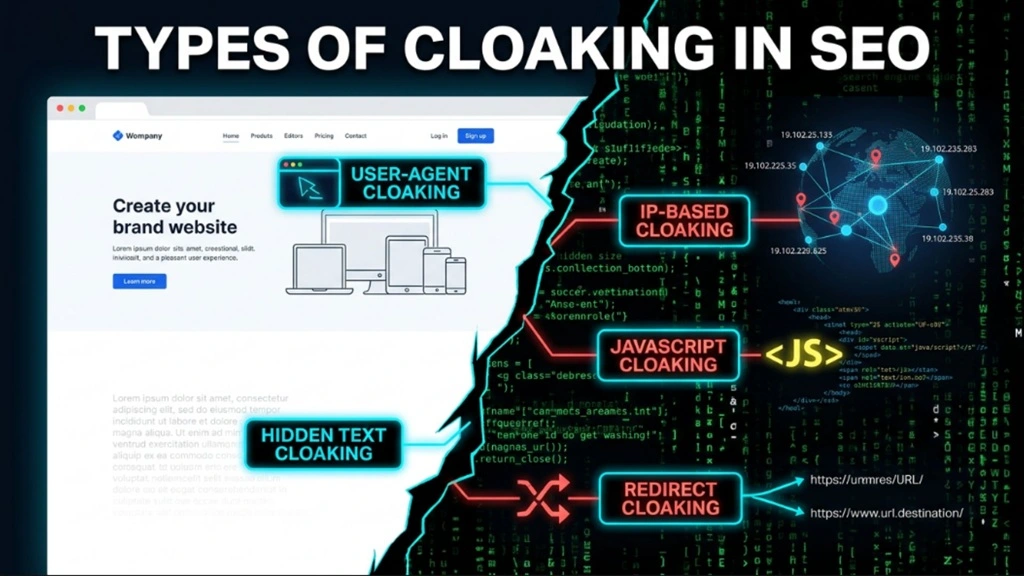
Cloaking in digital marketing is not just one technique. It can be implemented in multiple ways depending on how someone tries to manipulate search engines. Understanding these types is important because in interviews, most candidates only define cloaking but fail to explain how it actually works in real scenarios.
User-Agent Cloaking
This is the most commonly used type of cloaking. The website checks who is visiting the page and serves different content based on whether it is a search engine bot or a real user.
Real-life example: I have seen affiliate websites where Googlebot was shown a clean, well-written article targeting keywords like “best fitness supplements.” But when a real user clicked, they landed on a heavily promotional page filled with aggressive sales content.
IP-Based Cloaking
In this method, content changes based on the visitor’s IP address. The website identifies location or IP range and serves different versions of the page.
Real-life example: Some websites show clean content to users from regions where search engine crawlers are active, while showing ad-heavy or spammy pages to users from other locations to maximize monetization.
JavaScript Cloaking
JavaScript is used to modify content after the page loads, creating a difference between what search engines and users see.
Real-life example: A page shows a simple SEO-friendly article to Google, but once a user lands, JavaScript loads popups, ads, or even completely different content.
Hidden Text Cloaking
Keyword-rich content is added but hidden from users using styling techniques.
Real-life example: Pages where keywords are placed in white text on a white background. Users cannot see them, but search engines can read them.
Redirect Cloaking
Users are redirected to a different page than what search engines see.
Real-life example: A page ranks for “SEO course in Bangalore,” but when a user clicks, they are redirected to a completely different landing page or domain.
Cloaking in digital marketing includes user-agent cloaking, IP-based cloaking, JavaScript manipulation, hidden text, and redirects—all used to manipulate search rankings.
Is Cloaking Ever Allowed? (Latest Google Guidelines & Updates)
This is where most people get confused.
Not everything that looks like cloaking is wrong.
For example:
- Showing different languages based on user location
- Mobile vs desktop optimization
These are acceptable if the intent is not deceptive and the core content remains consistent.
Google clearly states that cloaking becomes a violation when it is used to manipulate rankings or mislead users:
https://www.seobility.net/en/wiki/Cloaking
Latest development:
Google’s spam detection systems are now powered by advanced AI models. These systems analyze:
- Content consistency
- User behavior
- Page structure
This makes detecting cloaking much easier than before.
Cloaking is only acceptable for user experience, not manipulation, and modern AI systems detect it more effectively.
Risks and Penalties of Cloaking in SEO
If you use cloaking, the risks are serious.
You may face:
- Ranking drops
- Manual penalties
- Complete deindexing
Google explicitly lists cloaking as a violation that can trigger penalties:
https://support.google.com/webmasters/answer/9044175
In real-world scenarios, websites have lost major traffic overnight due to cloaking practices, and recovery often takes months.
Cloaking can lead to severe penalties including ranking loss and removal from search results.
Cloaking vs Smart SEO (What You Should Do Instead)
Instead of using cloaking, focus on strategies that work long term.
This includes:
- Matching search intent
- Creating valuable content
- Building topical authority
- Improving technical SEO
Modern SEO is about transparency and delivering value.
Cloaking tries to manipulate the system, while smart SEO aligns with it.
Sustainable SEO focuses on user value and transparency, unlike cloaking which manipulates rankings.
What Is SSID Cloaking?
SSID cloaking is completely different from cloaking in SEO.
It is related to WiFi networks and means hiding your network name from public visibility.
It is used for security purposes and has no connection with SEO or digital marketing.
SSID cloaking is a networking concept and not related to SEO.
How To Detect Cloaking on a Website
If you suspect cloaking, there are practical ways to identify it.
You can compare how a page appears in your browser versus Google’s cached version. You can also use Google Search Console’s URL inspection tool to see how Google views the page.
Disabling JavaScript and analyzing redirects can also reveal differences.
If there is a clear mismatch between what users see and what search engines see, cloaking is likely being used.
Cloaking can be detected by comparing search engine view and user view of a page.
Conclusion
Cloaking in SEO may look like a shortcut, but it is one of the fastest ways to damage your website. It might give temporary results, but it leads to long-term losses. If you want sustainable growth, focus on strategies that align with Google’s guidelines.
Because in modern SEO, transparency and value always win.
FAQs
What is cloaking in SEO?
Cloaking in SEO means showing different content to search engines and users. For example, showing optimized content to Google but a different page to users. It is used to manipulate rankings and violates Google guidelines.
What does cloaking mean in black hat SEO?
Cloaking is a black hat technique where websites try to deceive search engines. For example, ranking for one topic but showing another to users. It can lead to penalties or de-indexing.
What is cloaking in digital marketing?
Cloaking in digital marketing refers to showing different content to users and search engines. It is used to manipulate visibility but is risky and not recommended.
Is cloaking illegal in SEO?
Cloaking is not illegal by law, but it violates Google guidelines and can lead to penalties.
What is SSID cloaking?
SSID cloaking means hiding your WiFi network name for security purposes and is unrelated to SEO.


Mohit Verma
Contributor at Mohit's SEO Training.