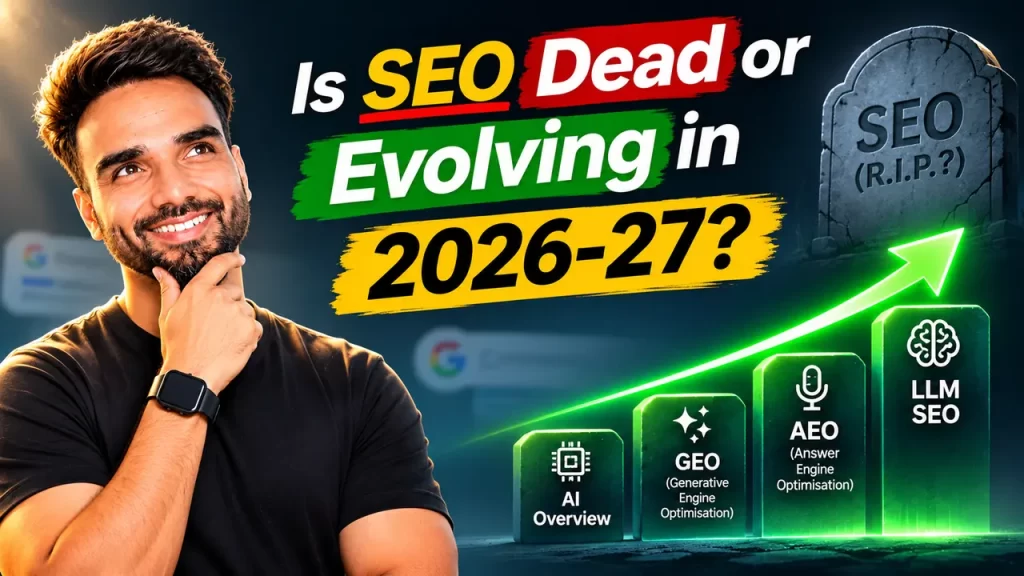
If you are learning SEO in 2026, you have heard it at least once this week: “SEO is dead, AI answers everything now.” The fear has numbers behind it. Ahrefs found that the top-ranking page gets 58% fewer clicks when Google shows an AI Overview, and a SparkToro and Similarweb study found that 68% of US Google searches end without a click. Yet businesses keep spending more on search: the global SEO services market stands at about $84 billion in 2026 and Mordor Intelligence projects it to reach nearly $149 billion by 2031. SEO is not dead. The click is shrinking, but the job is growing. In 2026 SEO means earning visibility wherever people search, including Google’s blue links, AI Overviews, ChatGPT and Perplexity, and measuring success in leads and revenue instead of raw traffic.
TLDR
SEO is evolving, not dying. AI Overviews and AI chatbots reduce clicks on simple informational queries, so the old model of “rank a blog, collect traffic” weakens. Google still handles around 90% of traditional search, AI tools cite the pages that SEO makes visible, and commercial searches still send clicks. The 2026 version of SEO adds generative engine optimization (GEO), answer engine optimization (AEO), entity and brand building, and AI-assisted workflows on top of technical and content fundamentals. Learners who build these skills face rising demand, not a dying field.
Why people keep saying SEO is dead in 2026?
The “SEO is dead” claim returns every few years. In 2026 it has got four real triggers.
AI Overviews answer questions on the results page
Google now summarises answers above the organic results. For a query like “what is canonical tag”, many users read the summary and leave without clicking any website.
ChatGPT and Perplexity act as search engines
Students and buyers now ask AI tools before they search Google. When an answer arrives in a chat window, publishers lose the visit.
AI content flooded the web
Anyone can publish 100 articles in a day. Generic content lost its value overnight, and sites built on thin content lost rankings in recent core updates.
Agencies sold outdated SEO
Many businesses paid for keyword stuffing, cheap backlinks and monthly ranking reports. When those tactics stopped working, owners blamed SEO itself rather than the method.
In short: People call SEO dead in 2026 because AI Overviews and chatbots answer questions without a click, AI content flooded search results, and outdated agency tactics stopped delivering. Each trigger is real, but each one kills a tactic, not the discipline.
What does the data actually say about SEO in 2026?
The numbers point in two directions at once. Clicks fall on informational queries while search usage and SEO investment keep growing.
| Signal | Data | What it means |
|---|---|---|
| Clicks with AI Overviews | Position 1 CTR drops 58% when an AI Overview appears (Ahrefs) | Informational traffic is shrinking |
| Informational CTR trend | Organic CTR on AI Overview queries fell 61% since mid-2024 (Seer Interactive via PPC Land) | Paid ads lose clicks too, not only SEO |
| Zero-click searches | 68% of US Google searches end without a click (SparkToro and Similarweb) | Visibility matters even without a visit |
| Google’s share | About 90% of worldwide search engine market share (StatCounter) | Google remains the main channel |
| ChatGPT search | Roughly 12% of Google’s search-like volume, but about 190 times less referral traffic (PPC Land) | AI tools answer, Google still sends visits |
| Market size | About $84 billion in 2026, forecast near $149 billion by 2031 (Mordor Intelligence) | Businesses are spending more, not less |
In 2024 Gartner predicted that traditional search volume would fall 25% by 2026 because of AI chatbots. Google still dominates search share today. The bigger change sits inside the results page, not in where people search.
In short: In 2026 clicks on informational queries are falling sharply because of AI Overviews, and most searches end without a click. At the same time Google keeps about 90% search share, ChatGPT sends far less traffic than Google, and SEO spending keeps rising toward $149 billion by 2031.
What has changed in SEO and what has not?
I tell my students to separate the tactics that died from the principles that got stronger.
| Area | What stopped working | What works in 2026 |
|---|---|---|
| Keywords | Exact-match stuffing, one page per keyword | Topic clusters built on intent and entities |
| Content | Long generic blogs written for word count | Original experience, data, examples and direct answers |
| Links | Bulk directories, paid link farms | Digital PR, brand mentions, relevant citations |
| Measurement | Rankings and sessions only | Leads, revenue, impressions, AI citations, branded search |
| Technical | Page speed alone | Crawlability for Google and AI crawlers, schema, clean indexing |
| Workflow | Manual audits and reports | AI agents connected to Search Console and GA4 |
What has not changed at all
Google still needs to crawl, index and understand your page. People still search with a problem and choose the source they trust. AI systems still pull answers from web pages, and Google’s guidance on AI features confirms that the same SEO best practices apply to appearing in them.
In short: Keyword stuffing, bulk links, word-count blogs and ranking-only reports have stopped working. Intent-based clusters, original expertise, digital PR, revenue reporting, AI crawler readiness and AI-powered workflows have replaced them. Crawling, indexing and trust still sit at the core.
What are GEO, AEO and LLM visibility?
These three terms describe how SEO extends into AI search. You do not need to treat them as separate careers. They are new layers of the same skill.
| Term | Full form | Goal | Example action |
|---|---|---|---|
| AEO | Answer engine optimization | Get your answer chosen for featured snippets, AI Overviews and voice results | Answer the question in the first 40 to 60 words under a question heading |
| GEO | Generative engine optimization | Get cited or mentioned inside AI-generated answers | Publish original data, comparisons and clear definitions that AI tools quote |
| LLM visibility | Large language model visibility | Make your brand known to ChatGPT, Claude, Gemini and Perplexity | Earn mentions on trusted sites, keep consistent brand facts, allow AI crawlers |
I covered the practical side in my guide on how to rank in ChatGPT and Perplexity. You can also create an llms.txt file for your site with my free LLM.txt generator.
In short: AEO helps your answer get picked for snippets and AI Overviews, GEO helps your content get cited inside AI answers, and LLM visibility helps AI models recognise your brand. All three build on standard SEO.
How do you do SEO that works in 2026?
Use this seven-step playbook. I apply it to client projects and teach it in every batch.
Step 1: Prioritise queries where clicks survive
Commercial and transactional searches such as “best SEO course in Bangalore”, “SEO agency pricing” or “buy running shoes” still drive clicks because people want to compare and act. Map your keywords by intent and give these queries your best pages.
Step 2: Answer informational queries for visibility, not traffic
Keep writing informational content, but measure it by impressions, AI citations and assisted conversions. A guide that gets cited in an AI Overview builds brand recall even when the visit never happens.
Step 3: Structure every page for extraction
Use question-based headings, put the direct answer first, add tables for comparisons, and add schema markup. AI systems and Google both extract cleanly structured content more easily.
Step 4: Add what AI cannot copy
Add first-hand experience, original screenshots, client data, test results and expert opinions. Generic definitions are available everywhere. Your own evidence is not.
Step 5: Build your brand as an entity
Keep brand facts consistent
Use the same name, description, founder details and services across your website, Google Business Profile, LinkedIn and directories.
Earn mentions, not just links
Get featured in industry articles, podcasts, news sites and comparison lists. AI tools rely on how often and where trusted sources mention you.
Step 6: Prepare your site for AI crawlers
Check that your robots.txt does not block the crawlers you want, keep important content in HTML rather than images, and fix indexing issues in Search Console. My free robots.txt checker helps with the first step.
Step 7: Measure what matters
Track leads, sales, branded searches, impressions and AI mentions alongside clicks. Report business outcomes. A client who sees enquiries growing does not panic when sessions dip.
In short: SEO that works in 2026 targets commercial queries for clicks, uses informational content for visibility, structures pages for AI extraction, adds original evidence, builds the brand as an entity, opens the site to AI crawlers and reports on leads and revenue.
Will SEO be replaced by AI?
No, AI will not replace SEO, because AI search depends on the web content that SEO makes discoverable and trustworthy. AI will replace repetitive SEO tasks such as writing meta descriptions, clustering keywords and formatting reports. That shift changes the job rather than removing it. The SEO professional of 2026 and 2027 spends less time on manual tasks and more time on strategy, technical diagnosis, brand authority and building AI agents that automate routine work. People who refuse to use AI will struggle. People who learn to direct it will lead teams.
In short: AI replaces repetitive SEO tasks, not SEO itself, because AI answers still rely on discoverable, trusted web content. The role shifts toward strategy, diagnosis, authority and automation.
Is SEO still in demand as a career?
Yes, SEO remains in demand, but employers now ask for a different skill set. LinkedIn’s India head expects 75% of job skills to change by 2030, and SEO is a clear example. Job descriptions now mention AI search, GEO, automation and analytics alongside on-page and technical work.
| Skill | Demand trend in 2026 |
|---|---|
| Technical SEO and indexing | Strong and stable |
| AI search visibility (GEO, AEO) | Rising fast |
| SEO automation and AI agents | Rising fast |
| Analytics (GSC, GA4, Looker Studio) | Strong |
| Basic on-page and link submissions | Falling |
If you want to build the rising skills, my advanced online SEO training covers GEO, AEO and AI agent building in an 8-week program, and you can see every option on the SEO courses page.
In short: SEO careers are still in demand in 2026, but employers favour technical SEO, AI search visibility, automation and analytics over basic on-page and link submission work.
When should you double down on SEO?
Double down on SEO when your buyers research before they buy, when your competitors already rank, or when you depend heavily on paid ads. SEO compounds over time, while ad costs keep rising. Pause and rethink if you rely only on simple informational traffic for ad revenue, because AI Overviews hit that model hardest. Local businesses should double down now: people still click, call and visit from local results. My local SEO course teaches exactly that.
In short: Invest more in SEO when buyers research before purchase, competitors rank, or ad costs are rising. Rethink models that depend only on informational traffic. Local businesses benefit strongly from SEO in 2026.
How will SEO change in 2027?
I avoid exact predictions, but the trends already visible at the end of 2026 point in four clear directions. Plan your learning and your SEO strategy around them.
AI answers will cover more searches
Google keeps expanding AI Overviews and AI Mode. Seer Interactive advised brands to plan for click-through rates on high-funnel queries to fall a further 20% to 30%. Expect informational traffic to shrink further and AI citations to matter more.
AI chatbots will handle a bigger share of search
In November 2026, OpenAI said ChatGPT’s search-like query volume had reached about one-fifth of Google’s. Independent estimates put the share lower, but the direction is clear: more research now starts in a chat window.
AI agents will start searching on behalf of users
AI assistants increasingly browse, compare and shortlist options for people. Sites with clear pricing, structured data, crawlable content and consistent brand facts are easier for agents to read and recommend.
Measurement will move beyond clicks
Expect SEO reports to include AI citations, brand mentions in chatbots, share of voice and assisted conversions alongside clicks and rankings.
| 2027 trend | What to do now |
|---|---|
| More AI answers on Google | Target commercial queries and structure content for extraction |
| More search inside chatbots | Build brand mentions and publish original data |
| AI agents shortlisting options | Add schema, clear pricing and crawlable product or service details |
| Visibility beyond clicks | Track AI citations and branded search |
In short: In 2027 expect more AI answers on Google, more searching inside chatbots like ChatGPT, AI agents shortlisting options for users, and reports that track AI visibility beyond clicks. SEO skills built on structure, authority and original data will keep their value.
Frequently asked questions
Is SEO worth learning in 2026?
Yes, SEO is worth learning in 2026 if you learn the modern version that includes AI search. Every business that wants customers online needs someone who understands how Google and AI tools choose sources. Picture a D2C skincare brand that sees blog traffic falling: they do not need someone who writes more blogs, they need someone who can get the brand cited in AI answers and push buyers to product pages. That person is a 2026 SEO.
Does Google still matter if people use ChatGPT?
Yes, Google still matters a lot. Google holds about 90% of traditional search share and sends far more referral traffic than ChatGPT. Most people use both. A student might ask ChatGPT “what is the best SEO course” and then search the course name on Google to check reviews and fees, so you need visibility in both places.
Have AI Overviews killed blog traffic?
No, AI Overviews have not killed blog traffic, but they have cut clicks on simple informational queries. Blogs that offer original data, tools, comparisons and experience still earn clicks and citations. A “what is SEO” post loses traffic. A “SEO course fees in Bangalore compared” post still gets visits, because readers want the full table.
Is GEO replacing SEO?
No, GEO is not replacing SEO. GEO extends SEO into AI-generated answers, and it relies on the same foundations: crawlable pages, clear content, authority and brand trust. If a site cannot rank on Google, it rarely gets cited by AI tools either, because many AI answers draw on pages that already rank well.
Will SEO exist in 2030?
Yes, SEO will exist in 2030 in some form, because people will keep searching for solutions and businesses will keep competing for that attention. The interface will change, from blue links to AI answers to voice and agents. The skill of making a business the trusted answer will stay valuable. If you want to start building that skill with guidance, explore Mohit’s SEO Training.
Sources
- Ahrefs: AI Overviews reduce clicks
- Seer Interactive data via PPC Land
- SparkToro and Similarweb zero-click analysis via Business Journal Daily
- StatCounter search engine market share
- ChatGPT search volume vs traffic via PPC Land
- Mordor Intelligence SEO services market
- Gartner search volume prediction
- Google: AI features and your website
- LinkedIn India on skills change via Business Today

mohitverma
Mohit Verma is the founder and lead trainer of Mohit’s SEO Training, a Bangalore-based AI SEO training institute. With 12+ years of hands-on SEO experience, he has trained 500+ learners since 2022 and also runs the SEO agency Road To Top 5. Connect with him on LinkedIn or YouTube.