Most candidates fail SEO interviews not because they don’t know SEO, but because they give textbook answers without real understanding. If you can explain SEO in simple language with examples, you will stand out instantly.
I am writing this guide based on my experience of training students, taking interviews, and working with clients across industries. I have seen one common pattern.
People either overcomplicate answers or give definitions.
Interviewers don’t want that.
They want to see:
- How you think
- How you solve problems
- Whether you can apply SEO in real situations
This blog will help you do exactly that.
Who Is This SEO Interview Questions Guide For?
This guide is for:
- Freshers preparing for SEO interviews
- Candidates with 1–3 years of experience
- Students who know concepts but struggle to explain them
If you are someone who:
- Knows SEO but cannot explain confidently
- Gets stuck when asked practical questions
- Gives theoretical answers
Then this guide will fix that.
This guide is designed for freshers and early-stage SEO professionals who want to answer interview questions with clarity and practical understanding.
Level of Rounds in SEO Interviews
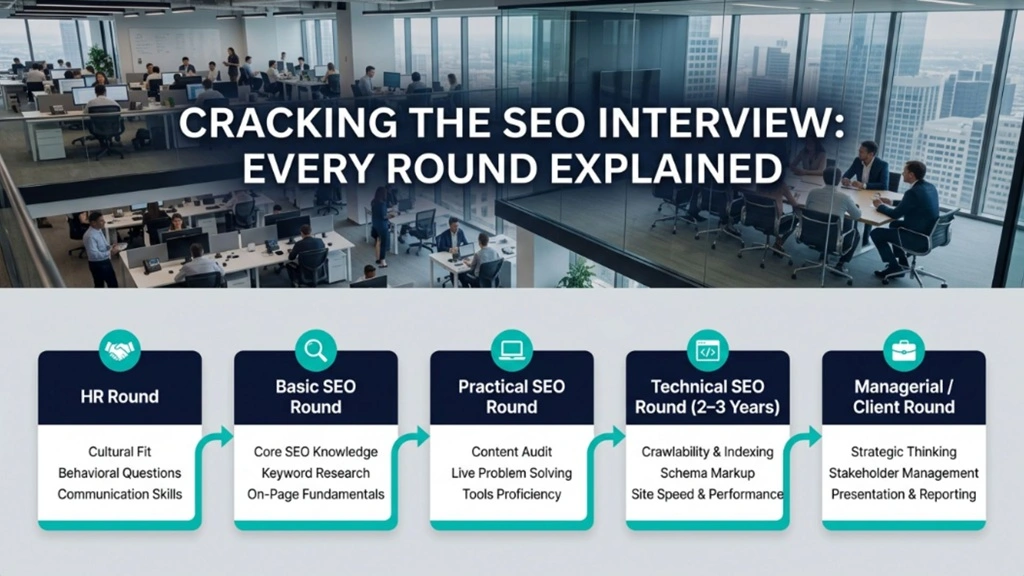
HR round
This is usually the first round where the focus is not deeply on SEO but on your communication, confidence, and basic understanding. They may ask simple questions like what SEO is, why you chose this field, or what you have learned so far.
For example, if you are a fresher, they are not expecting perfect answers. They just want to see if you can explain things clearly without sounding confused.
Basic SEO round
This round focuses on fundamentals. You will be asked questions around keywords, on-page SEO, backlinks, and basic tools like Google Search Console.
Here, most candidates fail because they give textbook definitions. If you explain concepts in simple language with examples, you already stand out.
For example, instead of defining backlinks, explain how getting a link from a good blog can improve rankings.
Practical SEO round
This is where your real understanding is tested. You may be asked how you will handle situations like traffic drop, indexing issues, or ranking problems.
At this stage, interviewers want to see how you think. Even if your answer is not perfect, your approach matters more.
For example, if traffic drops, you should say you will check Google updates, analyze pages, and identify patterns instead of guessing.
Technical SEO round (for 2–3 years)
If you have experience, this round becomes important. You will be asked about robots.txt, sitemap optimization, page speed, 4xx and 5xx issues, redirects, and similar topics.
Here, they expect hands-on knowledge. You should explain what you have actually done in projects.
For example, explaining how you used redirects during a migration is much stronger than just defining redirects.
Managerial or client round
In some companies, there is a final round where they check your thinking, problem-solving ability, and how you handle real scenarios or clients.
They may ask open-ended questions like how you will build an SEO strategy or improve rankings for a business.
Your ability to structure answers and think logically matters a lot here.
SEO interviews usually include HR, basic SEO, practical, technical, and sometimes managerial rounds, each testing different levels of understanding and real-world application.
SEO Interview Questions (Freshers – 0 to 1 Year)
What is SEO?
SEO is basically the process of making your website visible on Google when someone searches for something related to your business.
Don’t think of it as a technical term. Think of it like this.
If you have a shop in a crowded market, SEO is like putting your shop in the main street where people can easily find you.
For example, if someone searches “best hostel in Bangalore” and your page comes on page 1, that’s SEO working for you.
So in simple words, SEO is about:
- Getting visibility
- Bringing the right people
- And turning them into customers
Why is SEO important?
SEO is important because people search everything on Google before making decisions.
If your business is not visible there, you are missing opportunities.
For example, if someone searches “dentist near me” and your clinic is not showing, that customer will go to your competitor.
SEO helps you:
- Get consistent traffic
- Reduce dependency on ads
- Build long-term visibility
What is keyword research?
Keyword research means understanding what people are typing on Google.
But don’t just think of it as finding words.
It’s about understanding intent.
For example, someone searching “SEO” is just exploring.
But someone searching “SEO course in Bangalore fees” is ready to buy.
So instead of targeting broad keywords, I always suggest beginners focus on specific and intent-based keywords.
What is on-page SEO?
On-page SEO means improving things inside your website so Google can understand your content better.
This includes:
- Title
- Meta description
- Headings
- Content
Example:
If your keyword is “SEO course review”, you should naturally use it in your title and content.
But don’t force it. Write for users first, then optimize.
What is off-page SEO?
Off-page SEO is about building trust for your website.
Google trusts websites that other websites recommend.
That recommendation comes in the form of backlinks.
Example:
If a good blog links to your page, Google sees it as a positive signal.
It’s like someone referring your business to others.
What are backlinks?
Backlinks are the links from other websites pointing to your website.
But beginners make one mistake.
They think more backlinks = better rankings.
That’s wrong.
One strong backlink from a good website is better than 100 spammy links.
Example:
A backlink from a reputed blog will help more than links from random directories.
What is search intent?
Search intent means understanding why someone is searching.
This is very important.
For example:
If a user searches “best SEO tools”, they want a list.
If the user searches “buy SEO tools”, they want to purchase.
If your content does not match intent, it won’t rank.
What is indexing?
Indexing means your page is stored in Google’s database.
If your page is not indexed, it will never appear in search results.
Example:
You publish a blog but it doesn’t show on Google → it is not indexed.
That’s why we submit URLs in Google Search Console.
What is Google Search Console?
Google Search Console (GSC) is a tool that shows how your website is performing on Google.
You can see:
- Which keywords you rank for
- Which pages are indexed
- Errors in your site
Example:
If your page is not indexing, GSC will tell you the reason.
What is organic traffic?
Organic traffic is the traffic you get from Google without paying for ads.
Example:
Someone searches something, clicks your website, and lands on your page.
That is organic traffic.
What is a meta title and meta description?
Meta title is the heading you see on Google results.
Meta description is the small descriptive text in grey colors below it.
Example:
When you search something, the blue link is the title and the text below is the description.
A good title increases clicks.
What is URL structure in SEO?
URL should be simple and clear.
Bad example:
website.com/page?id=123
Good example:
website.com/seo-course-bangalore
Clean URLs help both users and Google understand your page.
What is internal linking?
Internal linking is linking one page of your website to another.
Example:
If you have a blog on SEO basics, you can link it to your SEO course page.
This helps:
- Users navigate
- Google understand your site
What is duplicate content?
Duplicate content means same or very similar content on multiple pages.
Google gets confused which one to rank.
Example:
If you create 3 pages targeting same keyword, none may rank properly.
Better approach:
Create one strong page instead.
What is alt text in images?
Alt text is the description of an image.
It helps Google understand what the image is about.
Example:
Instead of writing “image1”, write “SEO course classroom training”.
This also helps in image search rankings.
Tip (For Freshers)
Most freshers fail interviews because:
- They give definitions
- They don’t explain in simple language
Instead, do this:
- Explain like you are teaching a beginner
- Give real examples
- Show you understand how things work
Even if you don’t have experience, your clarity will make you stand out.
SEO Interview Questions (2–3 Years Experience – Advanced & Practical)
How do you optimize page speed of a website?
Page speed is not just about running PageSpeed Insights and fixing scores. It’s about improving actual user experience.
My approach is simple and practical.
First, I check tools like:
- Google PageSpeed Insights
- GTmetrix
Then I identify real issues.
Common fixes I implement:
- Compress images (WebP format)
- Lazy loading images
- Reduce unused CSS and JS
- Enable caching
- Use CDN
Example:
I worked on a website where images were 2–3 MB each.
After compressing and converting to WebP:
- Page load time dropped from 5 seconds to 2 seconds
- Bounce rate reduced
What are Core Web Vitals and how do you improve them?
Core Web Vitals are Google’s way of measuring user experience.
Main metrics:
- LCP (loading speed)
- CLS (layout shift)
- INP (interaction delay)
My approach:
- Improve LCP by optimizing images and server response
- Fix CLS by defining image sizes
- Improve INP by reducing heavy scripts
Example:
On one site, layout was shifting because images didn’t have dimensions.
After fixing that:
- CLS improved
- Rankings improved slightly
How do you handle indexing issues in a website?
Indexing issues are very common.
My process:
- Check GSC → Pages section
- Identify reasons (excluded, crawled but not indexed)
Then I fix based on problem:
- Improve content quality
- Fix internal linking
- Remove duplicate content
Example:
Client had 200 pages but only 50 indexed.
After improving content + internal linking:
- Indexing increased
- Traffic improved
What is crawl budget and how do you optimize it?
Crawl budget means how many pages Google crawls on your site.
Important for large websites.
My approach:
- Block useless pages via robots.txt
- Remove duplicate URLs
- Fix broken links
Example:
An eCommerce site had thousands of filter URLs.
After blocking them:
- Google focused on main pages
- Rankings improved
How do you perform a technical SEO audit?
I don’t use a checklist blindly.
I follow a flow:
Step 1: Check indexing
Step 2: Check crawl errors
Step 3: Check site speed
Step 4: Check structure
Tools I use:
- Screaming Frog
- GSC
- Ahrefs
Example:
In one audit, I found:
- Broken links
- Slow pages
- Duplicate titles
After fixing:
- Traffic increased in 2–3 months
What is canonical tag and when do you use it?
Canonical tells Google which page is the main version.
Used when:
- Duplicate content exists
- Similar pages exist
Example:
Same product in multiple URLs.
Instead of deleting, I used canonical.
Result:
- Duplicate issues resolved
- Ranking consolidated
How do you handle duplicate content issues?
Duplicate content confuses Google.
My approach:
- Use canonical tags
- Merge similar pages
- Rewrite content
Example:
Client had 5 blogs targeting same keyword.
I merged them into one strong page.
Result:
- Rankings improved
What is internal linking and how do you use it strategically?
Internal linking is underrated.
I use it to:
- Pass authority
- Improve crawling
- Boost rankings
Example:
I linked new blogs from high-traffic pages.
Result:
- Faster indexing
- Better rankings
How do you optimize a website after a redesign or migration?
This is where many websites lose traffic.
My process:
- Map old URLs to new URLs
- Apply 301 redirects
- Update sitemap
- Monitor GSC
Example:
During a migration, we redirected all old URLs.
Result:
- No traffic drop
How do you analyze competitors for SEO?
I don’t just see keywords.
I analyze:
- Their top pages
- Backlinks
- Content structure
Example:
If competitor ranks with 2000-word content, I don’t write 500 words.
I create better and more useful content.
How do you optimize content for search intent?
This is very important.
I check:
- What type of content ranks (blog, product, guide)
- What users actually want
Example:
If keyword is “best SEO tools”, user wants list.
Not theory.
So I create list-based content.
How do you track SEO performance?
I focus on business metrics, not just rankings.
I track:
- Organic traffic
- Conversions
- Leads
Example:
If traffic increases but leads don’t, SEO is not working properly.
Final Tip (For 2–3 Years Candidates)
At this level, your answers should always include:
- What you did
- Why you did
- What result you got
Don’t say:
“I know page speed optimization”
Say:
“I improved page speed from 5s to 2s by compressing images and reducing scripts”
That’s what gets you selected.
What Are Advanced SEO Interview Questions for 5+ Years Experience
These are real seo interview questions for 5 years experience, seo interview questions for experienced, and advanced seo interview questions and answers — and I’m explaining them the way I expect candidates to answer.
How would you rank a page in AI Overviews today
If someone answers this with “optimize content” — I know they are not updated.
My answer starts with understanding how AI Overviews work.
AI Overviews don’t rank pages like traditional SERPs. They summarize answers from multiple trusted sources. So the game shifts from ranking #1 to becoming a trusted source for extraction.
So my approach is:
First, I structure content in an answer-first format. The moment someone lands on the page, they should see a direct, clear answer. AI prefers content that is easy to extract.
Second, I focus on topical authority. One page won’t rank in AI Overviews. If I want to rank for “SEO interview questions,” I will create a cluster:
- SEO basics
- Technical SEO
- Advanced SEO
- AI SEO
All internally linked.
Third, I build entity and brand trust. AI doesn’t just pick content — it picks sources it trusts. So I make sure my brand appears across:
- Blogs
- Mentions
- Other websites
Real example:
I’ve seen pages with lower backlinks appear in AI Overviews simply because their answers were structured better and their site had strong topical depth.
How would you design an LLM SEO strategy for a brand
This question is not about SEO anymore. It’s about how search is evolving.
LLMs like ChatGPT or Google AI don’t “rank” pages. They generate answers. That means your goal is not ranking, it’s being referenced.
So my strategy would be:
First, I build entity-level presence. I make sure the brand is consistently mentioned across multiple trusted platforms. LLMs learn from data, not from your website alone.
Second, I focus on context-rich content. Instead of writing keyword-focused blogs, I create content that explains concepts deeply.
Third, I ensure consistency of information. If your brand is described differently across platforms, LLMs lose confidence.
Example:
If someone asks “best SEO training in India,” I want my brand to be mentioned across:
- Blogs
- Reviews
- Comparisons
This increases the probability of being picked in AI-generated answers.
How do you optimize for zero-click search
Most candidates think zero-click is bad.
I don’t.
Zero-click search means:
- User gets answer on SERP
- No click happens
But visibility still matters.
So my approach is:
I structure content to answer directly within 2–3 lines. Google prefers concise answers for featured snippets and AI Overviews.
Then I use:
- Lists
- Tables
- Definitions
Because structured content is easier to extract.
Example:
If the question is “What is SEO,” I start with:
“SEO is the process of optimizing a website to improve its visibility on search engines.”
Not storytelling. Direct answer.
But I also ensure the content gives reason to click:
- Deeper insights
- Examples
- Case studies
How do you approach crawl budget optimization on a large site
This is where I test whether someone has actually worked on large websites.
Crawl budget matters when you have thousands of pages.
My approach starts with identifying wasted crawl activity.
Using log files or tools, I check:
- Which pages Google is crawling
- Which pages are getting ignored
Common issues I fix:
- Duplicate pages
- Filter URLs
- Thin content
Example:
Ecommerce sites often have filter pages like:
?color=red&size=xl
These can eat crawl budget.
So I:
- Block unnecessary URLs
- Use canonical tags
- Strengthen internal linking to important pages
The goal is simple:
Guide Google towards pages that matter.
How do you debug a sudden traffic drop
This is a real-world question.
My approach is always structured.
First, I segment the drop:
- Which pages
- Which keywords
- Which location
Then I check:
- Algorithm updates
- Indexing issues
- Technical errors
Then I compare competitors:
- Did they improve
- Did intent shift
Example:
If a blog drops from position 2 to 8, I check:
- Has content become outdated
- Are competitors covering more depth
The key is:
Don’t guess. Diagnose.
How do you scale SEO for a large website
Scaling SEO is not about writing more content.
It’s about building systems.
I focus on:
- Programmatic SEO
- Templates
- Automation
Example:
Instead of manually creating pages for:
“hostels in Bangalore,” “hostels in Mumbai”
I create a template:
“hostels in [city]”
And scale using data.
But I also ensure:
- Content quality
- Internal linking
- No duplication
Scaling without quality kills SEO.
How do you build topical authority in competitive niches
Topical authority is about depth, not just content volume.
If I want to rank for SEO, I don’t write one blog.
I cover:
- Basics
- Advanced topics
- Technical SEO
- AI SEO
Then I interlink everything.
This tells Google:
“This site knows the topic completely.”
Example:
Instead of targeting 1 keyword, I dominate the entire category.
How do you measure SEO success beyond traffic
Traffic is a vanity metric.
I measure:
- Leads
- Conversions
- Revenue
Example:
If a page brings 10,000 visitors but no leads, it’s useless.
If another page brings 1,000 visitors but generates clients, that’s success.
SEO should align with business goals.
How do you decide whether to update or create new content
This depends on data.
If a page is ranking between:
- Position 5–15 → update
Because Google already recognizes it.
If there is no ranking:
- Create new page
Example:
If a blog is stuck at position 7, improving content depth can push it to top 3.
How do you align SEO with business goals
This is where most SEOs fail.
They chase traffic.
I map SEO to:
- Revenue
- High-intent keywords
Example:
Instead of targeting “what is SEO,” I target:
“SEO services in Bangalore”
Because it converts.
What I Actually Look for in 5+ Year SEO Candidates
At this level, I don’t evaluate knowledge.
I evaluate:
- Thinking
- Structure
- Real experience
- Business understanding
If someone gives examples → strong candidate
If someone gives definitions → reject
Advanced seo interview questions for experienced candidates require deep understanding of AI Overviews, LLM SEO, crawl budget optimization, scalability, and business alignment. Strong answers include structured thinking, real-world examples, and strategic clarity rather than short theoretical responses.
Perfect — this is exactly how you differentiate your content from 99% of SEO blogs.
Case-study based questions are what actually crack interviews, especially for 3–5+ years experience.
I’ll add real-world scenario questions with how to think + how to answer, not textbook responses.
Case Study Based SEO Interview Questions (Real-World Scenarios)
These are the kind of questions I ask when I want to filter serious candidates from average ones. These apply to seo interview questions for experienced, seo interview questions for 4 years experience, and seo interview questions for 5 years experience.
A page is ranking on position 5 for a high-intent keyword. What will you do to push it to top 3
Most candidates say “build backlinks.”
That’s incomplete.
My approach starts with identifying why it is stuck at 5.
Step 1: Analyze top 3 results
- What additional subtopics are they covering
- Content depth
- Structure
Step 2: Check intent alignment
Sometimes page is slightly misaligned with intent.
Example:
If keyword is “best hostels in Bangalore,” and your page is informational instead of comparison-based → you won’t move up.
Step 3: Improve content
- Add missing sections
- Improve clarity
- Add FAQs
Step 4: Internal linking
Push authority from other pages.
Step 5: External signals
Only after fixing content.
Real insight:
Most ranking jumps happen from content and intent fixes, not backlinks.
Your website traffic dropped by 40% overnight. What will you do
I look for structured thinking, not panic.
Step 1: Check if drop is real
- Compare GSC and GA
- Rule out tracking issues
Step 2: Segment the drop
- Which pages
- Which keywords
- Which geography
Step 3: Check algorithm updates
If yes → content or quality issue
Step 4: Check indexing
- Pages deindexed?
Step 5: Competitor analysis
- Did competitors improve?
Example:
If only blog pages dropped → content issue
If entire site dropped → technical issue
Strong candidates diagnose before acting.
You launched 100 new pages but none are getting indexed. What will you do
This tests technical + strategy thinking.
First thing I check:
- Crawlability
- Internal linking
- Sitemap inclusion
Then I check:
- Content quality
- Duplicate content
- Thin pages
Example:
If pages are similar with minor variations → Google ignores them.
Fix:
- Improve uniqueness
- Add internal links
- Submit in GSC
Insight:
Indexing is not technical alone. It’s also content quality + value.
A competitor with fewer backlinks is outranking you. Why
If someone says “Google is wrong,” reject.
Possible reasons:
- Better content depth
- Better intent match
- Strong topical authority
- Better UX
Example:
A page with 10 backlinks but strong topical coverage can outrank a page with 100 links.
So I analyze:
- Content gaps
- Structure
- Internal linking
Links are not everything anymore.
You have limited resources. Which SEO tasks will you prioritize
This is a business thinking question.
I use:
Impact vs Effort framework
Priority:
- Pages already ranking (quick wins)
- High-intent keywords
- Technical blockers
Example:
Fixing indexing issues > writing new blogs
Because fixing gives faster ROI.
A blog is getting traffic but no conversions. What will you do
This is where most SEOs fail.
Step 1: Check intent mismatch
Traffic may be informational
Step 2: Add conversion elements
- CTAs
- Internal links to money pages
Step 3: Improve content direction
Move from informational → commercial intent
Example:
“How to choose hostel” blog → link to “best hostels” page
SEO is not traffic. It’s conversion.
How would you approach SEO for a brand new website
I don’t start with backlinks.
Step 1: Keyword + intent mapping
Step 2: Build topical clusters
Step 3: Create foundational content
Step 4: Technical setup
Step 5: Internal linking
Then:
- Start link building
Example:
New site without structure + backlinks = wasted effort
You are asked to scale SEO from 100 to 10,000 pages. What will you do
Manual approach won’t work.
I use:
- Programmatic SEO
- Templates
- Data-driven pages
Example:
City-based pages:
“hostels in [city]”
But:
- Avoid duplication
- Add unique data
Scaling without quality = penalty risk.
A page is indexed but not ranking at all. Why
Possible reasons:
- Wrong intent
- Low content quality
- No authority
- Poor internal linking
Example:
If content is generic and competitors are detailed → you won’t rank.
Fix:
- Improve depth
- Add structure
- Align intent
How would you rank a page in a highly competitive niche
I don’t try to beat competitors directly.
I:
- Find content gaps
- Target long-tail clusters
- Build topical authority
Example:
Instead of targeting “SEO,” target:
- “SEO for dentists”
- “SEO for startups”
Then expand.
How would you make content AI-friendly for LLMs
I focus on:
- Clear answers
- Structured format
- Entity coverage
Example:
Instead of long paragraphs, I use:
- Headings
- Lists
- Direct answers
Because AI extracts structured content easily.
You have 10,000 pages but only 1,000 get traffic. What will you do
I:
- Identify low-value pages
- Improve or remove them
- Consolidate content
Example:
Thin pages dilute authority.
Better:
100 strong pages > 10,000 weak pages
What I Actually Evaluate in Case Study Questions
I’m not looking for perfect answers.
I’m looking for:
- Structured thinking
- Logical steps
- Real-world examples
- Prioritization
If someone jumps to solutions without analysis → reject
If someone explains step-by-step → strong candidate
Case study based seo interview questions test real-world problem-solving ability including ranking improvement, traffic drops, indexing issues, scaling SEO, and AI optimization. Strong answers focus on structured thinking, diagnosis, and execution rather than generic solutions.

Mohit Verma
Contributor at Mohit's SEO Training.