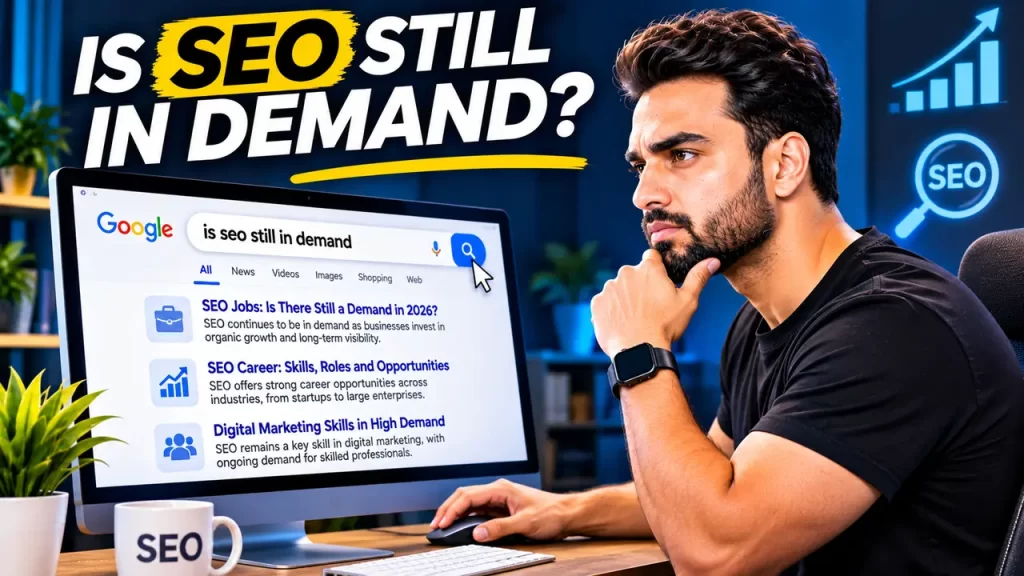
If you work in SEO or plan to, 2026 has given you plenty to worry about. A Content Marketing Institute survey found that 43% of marketers saw layoffs in their organisations within a year, and the Previsible State of SEO Jobs report recorded a 34% decline in SEO role listings, with content-focused SEO roles down 28%. Yet businesses keep spending more on search, and a Semrush study of 3,900 SEO job listings shows the role being redefined around strategy, cross-channel visibility and measurable outcomes, with AI skills mentioned in 31% of senior listings. SEO is still in demand, but the demand has moved. Companies hire fewer people for repetitive SEO tasks and compete hard for people who combine technical SEO, AI search visibility, automation and business results. If you build those skills, 2026 and 2027 are good years to be in SEO.
TL;DR
SEO remains in demand in 2026, but not in the same form as five years ago. Listings for basic and content-only SEO roles have fallen, entry-level hiring has slowed, and many teams are smaller. At the same time, the global SEO services market keeps growing, senior and specialist roles are in demand, and job descriptions increasingly ask for AI search, GEO, AEO and automation skills. In India, recruiters struggle to find qualified candidates even though applicants per job have doubled. To stay in demand, specialise, learn AI search and automation, show results in numbers and consider global clients.
Is SEO still in demand in 2026?
Yes, SEO is still in demand in 2026, but the data shows a split market. Some signals are negative and some are strongly positive.
| Signal | Data | What it means |
|---|---|---|
| SEO job listings | Down 34% overall, content SEO down 28% (Previsible via Digital Thrive) | Fewer roles for basic and content-only SEO |
| Role definition | Roles shifting toward strategy and measurable outcomes (Semrush) | Employers want decision-makers, not task-doers |
| AI skills in listings | Mentioned in 31% of senior listings and 22.3% of other roles (Semrush) | AI fluency is becoming a hiring filter |
| Market size | About $84 billion in 2026, forecast near $149 billion by 2031 (Mordor Intelligence) | Businesses keep investing in search |
| Marketing hiring plans | 65% of marketing leaders planned to expand permanent headcount in the first half of 2026 (Robert Half via Seoteric) | Overall marketing demand remains healthy |
In short: SEO is still in demand in 2026. Listings for basic and content-only SEO roles have dropped, but the SEO market keeps growing, marketing leaders plan to hire, and employers increasingly want strategic, AI-fluent SEO professionals.
Why does it feel like SEO demand is falling?
The anxiety in the SEO industry is real. I hear it from students, working professionals and agency owners every week. Here are the five insecurities behind it.
Layoffs and smaller teams
Marketing teams have shrunk as companies cut costs. An SEOjobs.com survey reported by Search Engine Land found that 44% of SEO professionals are more worried about AI than a year ago, and their biggest concerns were smaller teams, keeping up with AI and tougher competition.
Fewer entry-level roles
Entry-level job postings across the US economy have fallen roughly 35% since January 2023, with AI cited as a factor, according to data summarised by Digitrendz. Freshers feel this most.
AI answers reducing website clicks
AI Overviews and chatbots answer many questions directly, so some businesses wonder whether SEO still pays off.
Too many people competing for basic roles
In India, LinkedIn research shows applicants per job have more than doubled since early 2022. Many SEO course graduates compete for the same entry-level openings.
Outdated courses and fake promises
Many courses still teach 2018-style SEO and promise jobs. Graduates of those courses struggle in interviews and conclude that SEO has no demand, when the real problem is an outdated skill set.
In short: SEO demand feels like it is falling because of layoffs and smaller teams, fewer entry-level postings, AI answers reducing clicks, heavy competition for basic roles, and outdated courses that leave graduates unprepared.
Which SEO skills are in demand and which are fading?
| Growing demand | Stable demand | Fading demand |
|---|---|---|
| AI search visibility (GEO, AEO, LLM citations) | Technical SEO and indexing | Manual link submissions and directories |
| SEO automation and AI agents | Local SEO for service businesses | Generic blog writing for word count |
| SEO strategy tied to revenue | Ecommerce and product page SEO | Ranking-only reporting |
| Analytics and experimentation | Content strategy and topical authority | Keyword stuffing and on-page checklists alone |
| International and multi-market SEO | Digital PR and brand mentions | Content spinning and mass AI pages |
In short: In 2026 demand is growing for AI search visibility, SEO automation, revenue-focused strategy, analytics and international SEO. Technical, local, ecommerce and content strategy skills stay stable. Manual link building, word-count blogging and ranking-only reporting are fading.
Who is hiring SEO professionals now?
Larger companies drive most SEO hiring. The 2025 Previsible report found that 90% of open SEO positions were at companies with more than 250 employees. The same report found that most brands do not require a degree for SEO roles, which keeps the door open for skilled self-starters.
| Employer type | What they want |
|---|---|
| SaaS and technology companies | Technical SEO, content strategy, pipeline growth |
| Ecommerce and D2C brands | Category and product SEO, site architecture, AI shopping visibility |
| Agencies serving global clients | Versatile SEOs who can manage several accounts |
| Global capability centres in India | Enterprise SEO, analytics, international SEO |
| Local service businesses | Local SEO, Google Business Profile, reviews |
| Foreign clients hiring freelancers | Specialists who deliver measurable results remotely |
In short: Most SEO hiring comes from companies with more than 250 employees, including SaaS, ecommerce, agencies and global capability centres. Local businesses and foreign clients also hire SEO freelancers, and most roles do not require a degree.
Is SEO in demand in India?
Yes, SEO is in demand in India, but competition for entry-level roles is intense. LinkedIn’s India research shows a clear mismatch: 74% of recruiters say qualified candidates have become harder to find, even as applicants per job have more than doubled. In other words, India has plenty of SEO applicants but too few job-ready ones. Bengaluru, Hyderabad, Gurugram, Mumbai and Pune host most of the better-paying roles, and remote work lets skilled SEOs in smaller cities work for these companies and for foreign clients. India’s cost advantage also makes Indian SEO professionals attractive to overseas businesses, which adds freelance demand on top of jobs.
In short: SEO is in demand in India, but recruiters struggle to find job-ready candidates while applicants for basic roles keep rising. Metro hubs offer the best roles, and remote work and foreign clients extend demand to smaller cities.
How do you stay in demand as an SEO professional?
This is the plan I give every student and working SEO who asks me how to stay relevant.
Step 1: Master technical SEO
Learn crawling, indexing, rendering, canonicalisation, hreflang and site architecture well enough to diagnose problems alone. Technical depth keeps you valuable even as tools change.
Step 2: Learn AI search visibility
Understand how AI Overviews, ChatGPT and Perplexity choose sources, and how to measure brand citations. My guide on how to rank in ChatGPT and Perplexity is a good starting point.
Step 3: Build AI agents and automations
Connect Claude or ChatGPT to Search Console and GA4, and automate reporting, audits and content briefs. Employers now look for people who can do more with fewer resources.
Step 4: Tie every project to business results
Report leads, sales and revenue, not just rankings. People who speak in business outcomes survive team cuts.
Step 5: Pick a specialisation
Choose technical, ecommerce, SaaS, local or international SEO. Specialists stay in demand when generalist roles shrink.
Step 6: Build visible proof and a global client base
Publish case studies, share insights on LinkedIn and take at least one foreign client. Multiple income sources protect you from layoffs.
In short: Stay in demand by mastering technical SEO, learning AI search visibility, building AI agents, tying work to business results, specialising, and building public proof plus a global client base.
Will SEO be in demand in 2027 and beyond?
Yes, I expect SEO to stay in demand through 2027 and beyond, because businesses will keep competing for attention wherever people search, whether on Google, in AI Overviews, inside ChatGPT or through AI agents that shop on a user’s behalf. The job titles may change. Some companies already hire for “AI search” or “organic growth” roles that cover SEO, GEO and AEO together. LinkedIn’s India head expects 75% of job skills to change by 2030, so the people who keep updating their skills will see more demand, and those who stop learning will see less.
If you want a structured way to build these skills, my advanced online SEO training covers technical SEO, GEO, AEO and AI agent building over 8 weeks. Business owners and founders can choose the one-on-one SEO training, and the local SEO course suits anyone serving nearby customers. All programs are listed on the SEO courses page.
In short: SEO will stay in demand in 2027 and beyond as businesses compete for visibility across Google, AI answers and AI agents. Job titles and skills will change, so continuous learning decides who benefits from that demand.
Frequently asked questions
Is SEO a good career in 2027?
Yes, SEO is a good career in 2027 for people who learn modern SEO, including AI search and automation. Picture two SEOs in 2027: one still sends ranking reports, the other shows a founder how the brand appears in ChatGPT answers and how organic leads grew. Only the second one feels secure, and that difference comes from skills, not from the field.
Are SEO jobs disappearing because of AI?
No, SEO jobs are not disappearing, but repetitive SEO tasks are. AI writes meta tags, clusters keywords and formats reports in seconds, so roles built only on those tasks shrink. Roles that need judgement, technical diagnosis, strategy and AI search skills keep growing.
Do companies still hire SEO freshers?
Yes, companies still hire SEO freshers, but fewer than before and with higher expectations. Freshers who bring a live website, an audit and a case study get shortlisted. A fresher who walks in with Search Console screenshots of their own site growing from zero usually beats ten candidates who only have certificates.
Is freelance SEO in demand?
Yes, freelance SEO is in demand, especially among small businesses and foreign clients who cannot hire a full-time SEO. A US dental clinic, a UK ecommerce store or an Australian SaaS startup often prefers a specialist freelancer on a monthly retainer to a full-time hire, which creates steady work for skilled Indian SEOs.
Which industries need SEO the most?
SaaS, ecommerce, healthcare, education, finance, legal and local services need SEO the most, because their customers research online before buying. A local chartered accountant firm, for example, depends on appearing for “CA near me” searches just as much as a SaaS company depends on ranking for software comparisons. To learn the skills these industries pay for, explore Mohit’s SEO Training.
Sources
- Semrush: What 3,900 SEO job listings reveal for 2026
- Digital Thrive: Previsible State of SEO Jobs findings
- Digitrendz: CMI layoffs and entry-level postings data
- Search Engine Land: SEOs more worried about AI this year
- Bruce Clay: SEO hiring trends (Previsible data)
- Seoteric: Robert Half marketing hiring data
- Mordor Intelligence: SEO services market
- Careers360: LinkedIn India hiring research
- Business Today: LinkedIn India on skills change

mohitverma
Mohit Verma is the founder and lead trainer of Mohit’s SEO Training, a Bangalore-based AI SEO training institute. With 12+ years of hands-on SEO experience, he has trained 500+ learners since 2022 and also runs the SEO agency Road To Top 5. Connect with him on LinkedIn or YouTube.