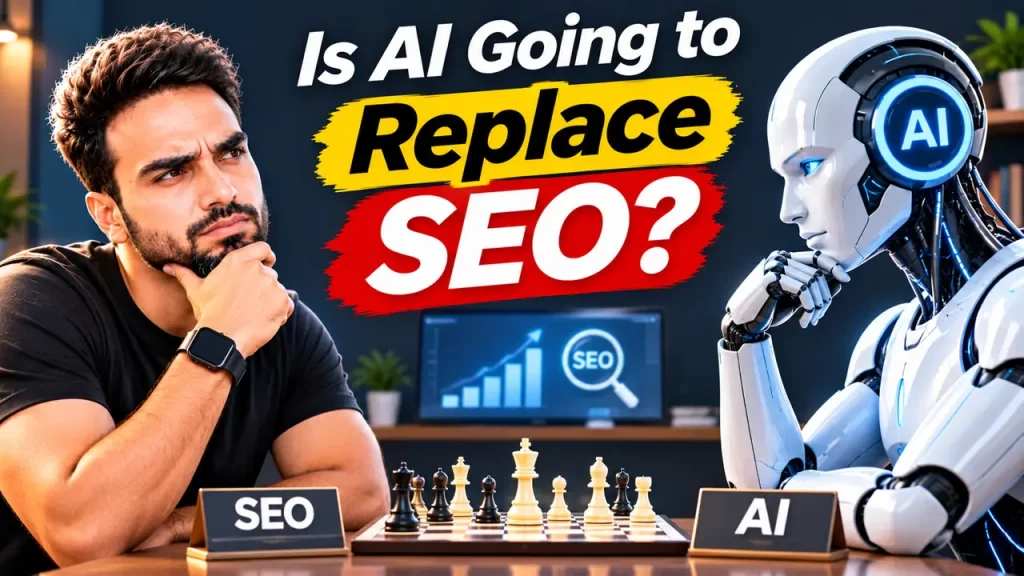
Every week someone asks me whether they are learning a skill that AI will kill. The fear has numbers behind it. A Funnel survey reported by MediaPost found that 64% of marketers believe AI may or will replace their jobs within five years, and an SEOjobs.com survey found that 44% of SEO professionals are more worried about AI than a year ago. Yet the search results tell a different story. Ahrefs found that fully AI-generated pages made up only 4.6% of top-20 results and rarely ranked first, and a 2026 follow-up showed that 54.7% of pages in Google’s top three contain less than 20% AI-generated text. AI is not replacing SEO. It is replacing SEO tasks and the SEO professionals who refuse to change. The discipline of making a business the trusted answer, on Google and inside AI tools, is growing. The people who direct AI will replace the people who compete with it.
TL;DR
AI already handles many repetitive SEO tasks: keyword clustering, meta tags, schema, first drafts, report summaries and basic audits. It cannot replace judgement, business strategy, technical diagnosis in context, original experience, relationships or accountability for results. Search itself still runs on web content that SEO makes discoverable, and AI answers cite pages that rank and earn trust. Jobs are changing: smaller teams, fewer pure task roles, more demand for AI search, automation and strategy skills. To stay AI-proof, learn AI search visibility (GEO and AEO), build AI agents, own business outcomes and specialise.
Is SEO being replaced by AI?
No, SEO is not being replaced by AI, but parts of SEO work are. The clearest way to see this is to split SEO into tasks.
| SEO task | What AI does to it | Human role now |
|---|---|---|
| Meta titles and descriptions | Largely automated | Review for brand and click appeal |
| Keyword clustering | Largely automated | Feed real data and check intent |
| Schema markup | Largely automated | Validate and choose the right types |
| First drafts of content | Partly automated | Add experience, data and accuracy |
| Reporting | Partly automated | Interpret and connect to revenue |
| Technical audits | Assisted | Diagnose root causes and prioritise |
| SEO strategy | Assisted | Decide priorities for the business |
| Digital PR and relationships | Barely affected | Earn trust and mentions |
| AI search visibility | New work created by AI | Get the brand cited in AI answers |
In short: AI is replacing repetitive SEO tasks such as meta tags, keyword clustering, schema and first drafts, but not SEO itself. Strategy, diagnosis, relationships and AI search visibility still need people, and AI has created new SEO work.
Why are SEO professionals afraid of AI?
The fear is understandable. Here are the insecurities I hear most, and what is actually true about each.
“AI writes content, so content SEOs are finished”
AI writes average content quickly. Listings for content-focused SEO roles have fallen, as the Previsible State of SEO Jobs data shows. But top rankings still lean toward pages with strong human input, so content SEOs who add expertise and strategy remain valuable.
“AI answers mean nobody clicks websites”
Clicks on informational queries have fallen because of AI Overviews. Commercial and transactional searches still drive visits, and AI tools cite websites as sources, so the job shifts toward earning citations and converting fewer, better visitors.
“Companies will cut SEO teams”
Teams are getting smaller. In the SEOjobs.com survey, smaller teams and keeping up with AI worried SEOs more than outright job loss. Companies cut people who only execute tasks and keep people who drive outcomes.
“Freshers will never get hired”
Entry-level hiring is tougher, because AI covers many tasks juniors once did. Freshers who arrive already using AI tools and showing results still get hired.
“My skills will become outdated”
This fear is the most valid one. Skills do go out of date quickly. The solution is continuous learning, not leaving the field.
In short: SEO professionals fear AI because it writes content, reduces clicks, shrinks teams, squeezes entry-level roles and outdates skills. Each fear is partly true, and each points to the same answer: move from task execution to strategy, expertise and AI-assisted work.
What can AI not replace in SEO?
Business judgement
AI does not know which keyword matters most to your client’s margins, which product line the founder wants to push, or which page will bring leads instead of empty traffic.
Technical diagnosis in context
AI can explain a crawl report. Finding why 40,000 product pages dropped out of the index after a platform change still needs someone who understands that site, its history and its developers.
Original experience and data
AI cannot test a product, interview customers or run an experiment on a live site. Content built on real experience stands out in a web full of AI text.
Relationships and trust
Links, PR features, partnerships and client trust come from people dealing with people.
Accountability
When traffic drops after a core update, a business needs someone to explain what happened and fix it. AI does not take responsibility for results.
In short: AI cannot replace business judgement, technical diagnosis in context, original experience and data, relationships and trust, or accountability for results. These remain the core of a valuable SEO career.
How is AI changing day-to-day SEO work?
| Area | Before AI | With AI in 2026 |
|---|---|---|
| Keyword research | Hours in spreadsheets | Minutes of clustering, more time on intent and priority |
| Content | Writers draft from scratch | AI drafts, experts add depth, data and experience |
| Audits | Manual checks of crawl exports | AI summarises issues, SEO decides fixes |
| Reporting | Monthly slide decks | Automated dashboards and AI agent alerts |
| Visibility goals | Rankings and clicks | Rankings, clicks and AI citations |
| Team size | Larger teams of task executors | Smaller teams of AI-fluent specialists |
The Semrush analysis of 3,900 SEO job listings reflects this change, with AI skills mentioned in 31% of senior listings and the role shifting toward strategy and measurable outcomes.
In short: AI is changing SEO work by automating research, drafting, audit summaries and reporting, while adding AI citations as a new visibility goal. Teams are smaller and expect each person to use AI to deliver more.
Will AI replace SEO jobs for freshers?
AI is making the first SEO job harder to get, but not impossible. Many tasks juniors used to learn on, such as writing meta tags or building link lists, are now automated, so companies hire fewer pure beginners. The freshers I see getting hired do three things differently: they arrive already using AI tools for research and drafting, they show a live website or audit with real data, and they understand AI search basics such as how AI Overviews pick sources. A fresher who can do in a day what used to take a week is still an attractive hire.
In short: AI reduces the number of pure beginner SEO roles, but freshers who use AI tools, show proof of work on a live site and understand AI search still get hired.
How do you make your SEO career AI-proof?
Follow these six steps. They are the same ones I build into my training.
Step 1: Use AI every day
Use ChatGPT, Claude or Gemini for clustering, briefs, schema, regex and summaries. Become the fastest person on your team, not the one avoiding the tools.
Step 2: Learn AI search visibility
Study how AI Overviews, ChatGPT and Perplexity choose sources, and how to track brand mentions in them. Start with my guide on how to rank in ChatGPT and Perplexity.
Step 3: Build your own AI SEO agents
Connect an AI model to Search Console and GA4 through tools such as MCP servers, and automate weekly checks for pages losing clicks, indexing errors and content gaps. People who build automation are rarely the ones automated away.
Step 4: Own a business number
Take responsibility for organic leads, signups or revenue. Report outcomes, not activity.
Step 5: Go deep in one area
Technical, ecommerce, international, local or SaaS SEO. Depth protects you; shallow generalist skills are easiest for AI to copy.
Step 6: Build your personal brand
Share insights, case studies and experiments publicly. A visible expert gets offers and clients even when the job market slows.
In my advanced online SEO training, students build their own AI SEO agents alongside technical SEO, GEO and AEO in 8 weeks. Founders who want a personal setup can choose the one-on-one SEO training. Compare all options on the SEO courses page.
In short: Make your SEO career AI-proof by using AI daily, learning AI search visibility, building AI SEO agents, owning a business number, specialising and building a visible personal brand.
What will SEO look like with AI in 2027?
By 2027 I expect AI to be part of every stage of SEO work, the same way crawlers and analytics became standard years ago. AI answers will cover more searches, AI agents will start browsing and shortlisting options for users, and businesses will measure visibility across Google, AI Overviews and chatbots together. The SEO professional of 2027 will act more like a search strategist who directs AI agents, protects technical health, builds brand authority and proves revenue impact. The role will be smaller in headcount and bigger in impact.
In short: In 2027 SEO will run with AI at every stage. SEO professionals will direct AI agents, protect technical health, build brand authority and measure visibility across Google and AI tools, working in smaller but higher-impact teams.
Frequently asked questions
Will ChatGPT replace SEO experts?
No, ChatGPT will not replace SEO experts, because it cannot see a business’s live data by default, judge priorities or take responsibility for results. It replaces the slow parts of an expert’s day. An SEO expert who used to spend three hours on keyword grouping now spends ten minutes, and uses the saved time on strategy and client growth.
Will Google stop needing websites because of AI?
No, Google still needs websites, because its AI Overviews and AI Mode build answers from web content. If websites stopped publishing, AI answers would have nothing reliable to draw from. That is why being the source that AI cites has become a core SEO goal.
Can AI agents do SEO automatically?
AI agents can automate many SEO tasks, such as monitoring Search Console, flagging errors, drafting briefs and creating reports, but they still need a human to set goals, check output and make decisions. Think of an agent as a tireless junior assistant: very fast, never bored, but in need of a manager who knows what good looks like.
Should I still learn SEO if AI keeps improving?
Yes, you should still learn SEO, as long as you learn the modern version that includes AI tools, AI search visibility and automation. A student who learns SEO and AI together in 2026 enters the market with exactly the combination employers find hardest to hire.
Is GEO replacing SEO?
No, generative engine optimization is not replacing SEO. GEO extends SEO into AI-generated answers and relies on the same foundations: crawlable pages, clear content, authority and brand trust. Most brands that appear often in AI answers already rank well in traditional search. To learn both together, explore Mohit’s SEO Training.
Sources
- MediaPost: Funnel survey on marketers and AI
- Search Engine Land: SEOs more worried about AI this year
- Ahrefs: AI-generated content and Google rankings
- Search Engine Journal: AI-flagged pages in Google’s top 10 (2026)
- Digital Thrive: Previsible State of SEO Jobs findings
- Semrush: What 3,900 SEO job listings reveal for 2026

mohitverma
Mohit Verma is the founder and lead trainer of Mohit’s SEO Training, a Bangalore-based AI SEO training institute. With 12+ years of hands-on SEO experience, he has trained 500+ learners since 2022 and also runs the SEO agency Road To Top 5. Connect with him on LinkedIn or YouTube.