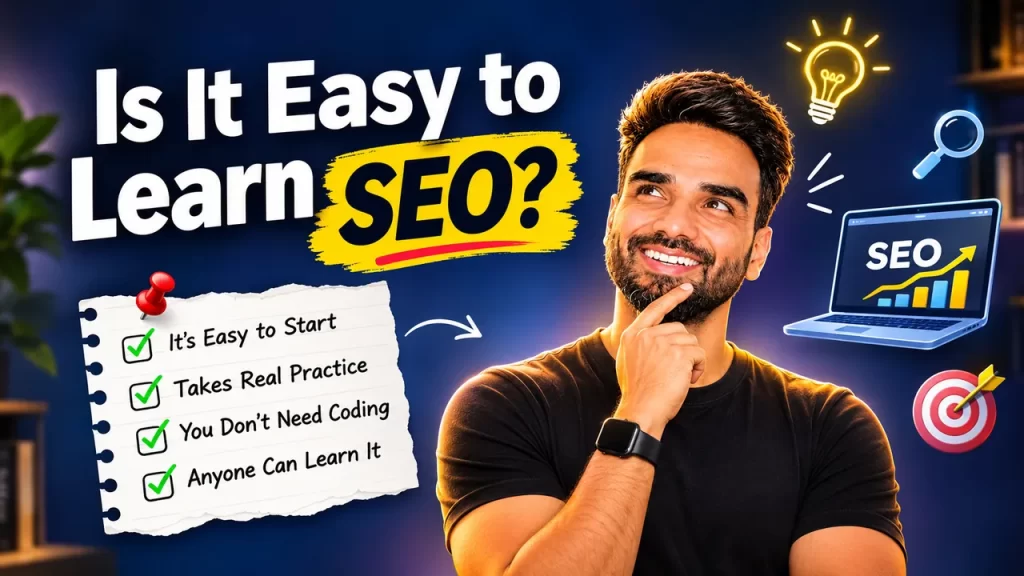
You have watched dozens of SEO videos, finished a free certificate, and you still cannot rank a page or clear an interview. That is a common problem, and the data explains it. LinkedIn’s 2026 research shows that 74% of recruiters in India find it harder to hire qualified candidates, while applicants per job have more than doubled since early 2022. Companies are not short of people who have studied SEO. They are short of people who can do it. SEO is easy to start and hard to master. You can understand the basics in four to six weeks and become job-ready in about 90 days, but only if you practise on a live website, learn how AI search changes ranking, and build proof of work instead of collecting certificates.
TLDR
Learning SEO is easy at the concept level and hard at the execution level. The fundamentals (how Google crawls, indexes and ranks pages, keyword intent, on-page structure) take a few weeks. Technical SEO, authority building and AI search visibility take longer because they need practice on real websites. In 2026, and even more in 2027, you also need to understand AI Overviews, generative engine optimization (GEO) and answer engine optimization (AEO), and how to use AI tools and agents to work faster. A focused 12-week plan with a live site, Google Search Console, and one real case study makes you employable. Watching tutorials without practice does not.
What does learning SEO actually mean in 2026?
Learning SEO no longer means learning keywords and meta tags. When I started more than 12 years ago, you could rank with a well-optimised title and a few links. Today you need to understand how Google’s systems and AI answer engines decide which source deserves visibility. I break modern SEO into six layers.
The six layers of modern SEO
| Layer | What you learn | Beginner difficulty | Time to basic competence |
|---|---|---|---|
| Search fundamentals | Crawling, indexing, ranking, search intent | Easy | 1 week |
| On-page and content | Keyword research, topic clusters, page structure, helpful content | Easy to medium | 2 to 3 weeks |
| Technical SEO | Site architecture, canonical tags, noindex, hreflang, Core Web Vitals, indexing errors | Hard | 3 to 4 weeks |
| Authority | Backlinks, digital PR, brand mentions, local citations | Medium to hard | Ongoing |
| AI search visibility | AI Overviews, GEO, AEO, citations in ChatGPT and Perplexity | Medium | 2 weeks for basics |
| Analytics and automation | Google Search Console, GA4, AI agents, reporting | Medium | 2 weeks |
Knowing SEO vs Doing SEO
Knowing SEO means you can explain what a canonical tag does. Doing SEO means you can look at a site with 4,000 “Crawled, currently not indexed” URLs, find the cause, and fix it. Interviews and clients test the second skill. Most free courses only teach the first.
In short: Learning SEO in 2026 covers six layers: search fundamentals, on-page content, technical SEO, authority, AI search visibility, and analytics with automation. The first two are easy for beginners. Technical SEO and authority take practice on real sites. The difference between knowing SEO and doing SEO decides whether you get hired.
Why do most beginners find SEO hard?
SEO feels hard for reasons that have little to do with intelligence. I see the same five blockers in almost every batch of students.
Outdated and conflicting tutorials
YouTube still ranks videos that teach keyword density and directory submissions. Beginners follow them, see no results, and conclude that SEO is complicated. The problem is the source, not the subject.
No live website to practise on
You cannot learn swimming from a textbook. Without a live site connected to Google Search Console, you never see impressions, indexing errors or ranking movement, so you never get feedback.
Results take weeks to appear
A new page can take weeks to settle in rankings. Students expect results in days, lose patience, and quit before the learning loop completes.
Tools teach clicks, not thinking
Semrush and Ahrefs show you data. They do not tell you which keyword matters for a business, or why a competitor ranks. Students who learn tools before judgement end up with long reports and no strategy.
AI has made average content free
An Ahrefs study of 600,000 pages found that 86.5% of top-ranking pages contain some AI-generated content. When everyone can produce average content in seconds, average skills stop being valuable. You now need judgement, first-hand experience and data that AI cannot copy.
In short: Beginners struggle with SEO because of outdated tutorials, no live website, slow feedback, over-reliance on tools, and an internet flooded with AI content. Fix these five issues and SEO becomes a learnable, logical skill.
Can I learn SEO in 3 months?
Yes, you can become job-ready in 3 months if you spend 10 to 15 hours a week and practise on a live website. You will not become an expert in 3 months. Expertise comes from handling different websites, industries and algorithm updates over years. Here is the 12-week plan I recommend.
A realistic 12-week SEO learning plan
| Weeks | Focus | Output you should have |
|---|---|---|
| 1 to 2 | Search fundamentals, set up a WordPress site, connect Google Search Console and GA4 | A live site that Google has indexed |
| 3 to 4 | Keyword research and search intent | A keyword map of 30 to 50 keywords grouped by intent |
| 5 to 6 | On-page SEO and content structure | Five optimised pages with internal links and schema |
| 7 to 8 | Technical SEO | A full audit of your site and one real business website |
| 9 to 10 | Authority and local SEO | Five earned links or citations, one optimised Google Business Profile |
| 11 to 12 | AI search visibility, automation and portfolio | An AI visibility check, one working automation, one written case study |
What job-ready means after 90 days
- You can explain why a page ranks or does not rank, using Search Console data.
- You can run a technical audit and prioritise fixes by business impact.
- You can build a keyword map and a content brief that a writer can follow.
- You can check whether a brand appears in AI Overviews, ChatGPT and Perplexity.
- You can show one case study with before-and-after numbers.
What 3 months will not give you
Three months will not give you experience with large ecommerce sites, international SEO across 20 markets, or recovery from a core update. Those come from working on projects after your course. Anyone who promises you an “SEO expert” title in 30 days is selling you a shortcut that does not exist.
What changes for SEO learners in 2027?
The 12-week plan stays valid in 2027 because crawling, indexing, intent and authority do not change. What changes is the weight of the last two blocks. Employers increasingly expect AI search visibility and automation as standard skills, not extras, so give weeks 11 and 12 your full effort and keep practising both after the plan ends.
In short: You can learn SEO well enough to get hired in about 12 weeks with 10 to 15 hours of weekly practice on a live site. The plan moves from fundamentals to keywords, on-page, technical, authority, and AI search visibility, and ends with a case study. Expertise takes years of real projects.
How do I learn SEO step by step?
This is the exact sequence I follow with my students. Each step builds on the previous one, so do not skip ahead.
Step 1: Build a small live website
Buy a domain, install WordPress, and pick a niche you understand, such as a local service, a hobby or a product category. A real site gives you real data, which no simulation can match.
Step 2: Learn how Google finds and ranks pages
Read Google’s SEO Starter Guide once, end to end. Then submit your sitemap in Search Console and watch how Google discovers, crawls and indexes your pages.
Step 3: Master search intent before keywords
Search the keyword yourself and study what Google shows. If the top results are guides, a sales page will not rank. If they are product pages, a blog will not rank. Intent decides the format, and format decides whether you rank.
Step 4: Write and optimise pages that answer the query
Structure each page with a clear H1, question-based H2s, direct answers in the first lines of each section, internal links, and relevant schema. Follow Google’s guidance on helpful, people-first content.
Step 5: Audit your site like a technical SEO
What to check first
Check indexing status, canonical tags, noindex tags, redirect chains, broken links, page speed and mobile usability. Then learn the difference between “Discovered, currently not indexed” and “Crawled, currently not indexed”, because interviewers love that question.
How to practise on a real site
Ask a local business, a friend’s startup or an NGO for permission to audit their website for free. One real audit teaches more than ten videos.
Step 6: Earn authority, not just backlinks
Learn guest posting, digital PR, unlinked brand mentions and local citations. Focus on relevance over volume. One link from a respected site in your niche beats fifty directory links.
Step 7: Optimise for AI search
Check whether your topic triggers an AI Overview and which sources it cites. Ask ChatGPT and Perplexity questions about your niche and note which brands they mention. I explain this process in my guide on how to rank in ChatGPT and Perplexity.
Step 8: Use AI tools and agents to work faster
Use ChatGPT or Claude for clustering keywords, drafting briefs, writing schema and summarising audits. Then go one step further and build a simple AI agent that pulls Search Console data and flags pages losing clicks. This skill already separates job-ready SEO professionals from the rest, and it will matter even more in 2027.
Step 9: Document everything as a case study
Write down the problem, what you changed, and what happened to impressions, clicks and rankings. Recruiters trust a one-page case study with screenshots more than any certificate.
In short: Learn SEO in nine steps: build a live site, understand crawling and indexing, master intent, optimise pages, audit technically, earn authority, optimise for AI search, use AI agents, and document results as a case study. Practice on real sites makes each step stick.
Which skills make learning SEO easier?
You do not need a technical degree to learn SEO. Some everyday skills, however, shorten your learning curve.
| Skill | Why it helps | Needed before you start? |
|---|---|---|
| Clear writing | Most SEO work involves content, briefs and reports | No, it improves with practice |
| Basic HTML | Helps you read source code, tags and schema | No, learn it in week 1 |
| Google Sheets or Excel | You will analyse keyword and crawl data constantly | Helpful |
| Business thinking | You prioritise work that drives leads and sales | No, develop it alongside SEO |
| Prompting AI tools | Saves hours on repetitive tasks | No, learn it during the course |
| Curiosity | SEO changes every year, so you keep learning | Yes |
In short: Curiosity is the only skill you must bring to SEO. Writing, basic HTML, spreadsheets, business thinking and AI prompting all help, and you can build each of them while you learn.
Should you learn SEO on your own or with a trainer?
Both paths work. The right choice depends on your discipline, your deadline and your budget.
| Factor | Self-learning | Trainer-led course |
|---|---|---|
| Cost | Free or low | Paid |
| Speed to job-ready | 6 to 12 months for most people | 2 to 3 months |
| Feedback on mistakes | None, unless you find a mentor | Direct, on your own work |
| Updated content | Depends on your sources | Depends on the trainer’s current work |
| Live projects | You must find them | Usually included |
| Interview preparation | Rarely | Often included |
If you learn alone, use Google’s documentation, Search Console and a live site, and test yourself regularly. If you want structure and feedback, choose a trainer who still works on client projects. In my advanced online SEO training, students work on live sites for 8 weeks, learn GEO and AEO, and build their own AI SEO agents. Founders who want personal guidance can join the one-on-one SEO training, and business owners who depend on nearby customers can take the local SEO course. You can compare all SEO courses in one place.
Questions to ask before you pay for any SEO course
- Does the trainer still do SEO for clients today?
- Will I work on a live website or only watch recordings?
- Does the course cover AI Overviews, GEO and AEO?
- Will I learn to build AI agents or automations?
- Does anyone promise me a job? If yes, be careful. Nobody can guarantee a job. A good course makes sure you start getting interviews through a proven framework.
In short: Self-learning costs less but usually takes 6 to 12 months and gives no feedback. A trainer-led course gets most students job-ready in 2 to 3 months with live projects and reviews. Choose a trainer who still practises SEO, teaches AI search, and avoids job guarantees.
Is SEO a stressful job once you learn it?
SEO carries moderate stress. The pressure comes from three places: algorithm updates that move rankings overnight, clients who expect results in weeks, and monthly reports that must explain every dip. The good news is that skill reduces stress. When you understand why traffic dropped, a core update becomes a diagnosis task, not a panic. I also tell students to set expectations in writing at the start of every project and to report on leads and revenue, not only rankings. Clients stay calmer when they see business impact.
In short: SEO has moderate stress driven by algorithm updates, client timelines and reporting. Strong diagnostic skills, written expectations and revenue-focused reporting reduce that stress significantly.
How do you know you have actually learned SEO?
Use this checklist. If you can do every item without searching for help, you have learned SEO at a job-ready level.
- Explain crawling, indexing and ranking to a non-technical person in two minutes.
- Fix a page that Search Console marks as “Crawled, currently not indexed”.
- Build a keyword map grouped by intent for a new website.
- Write a content brief that ranks a page in the top 10 within a few months.
- Implement canonical, hreflang and schema tags correctly.
- Check a brand’s visibility in AI Overviews, ChatGPT and Perplexity.
- Present a case study with real numbers.
For a quick self-test, take my free advanced SEO quiz. It covers technical SEO, indexing, topical maps, GEO, AEO, GA4 and Search Console, and your score shows whether you need to upskill.
In short: You have learned SEO when you can explain search fundamentals simply, fix indexing issues, map keywords, write briefs, implement technical tags, check AI visibility and present a case study. A free advanced SEO quiz gives you a quick benchmark.
Frequently asked questions
Can I learn SEO without coding?
Yes, you can learn and practise SEO without coding. Most SEO work involves research, content, analysis and strategy. You only need to read basic HTML so you can check title tags, canonicals and schema. Think of a commerce graduate who has never written code: in the first week they learn to open “View page source”, find the title tag and spot a missing canonical. That level of HTML is enough for most SEO jobs.
Can I learn SEO for free?
Yes, you can learn SEO fundamentals for free using Google Search Central documentation, Search Console and a cheap live website. The free path is slower because nobody reviews your work. Many self-learners spend months repeating the same mistake, such as targeting a keyword with the wrong intent, simply because no one points it out.
Is SEO hard for non-technical graduates?
No, SEO is not hard for non-technical graduates. Arts, commerce and management students often do well because they write clearly and think about customers. Technical SEO feels new at first, but it follows clear rules. A BBA student who understands why a customer searches “best CA near me” already understands search intent better than many engineers.
Do I need my own website to learn SEO?
Yes, you should build your own website to learn SEO properly. A small WordPress site costs very little and gives you real Search Console data. Without it, you learn theory but never see how Google reacts to your changes, which is the feedback that turns knowledge into skill.
Can I get an SEO job after learning for 3 months?
Yes, you can get an entry-level SEO job after 3 months if you can show practical work. Recruiters shortlist candidates who bring a live site, an audit and a case study. Imagine two freshers in an interview: one shows a certificate, the other shows a Search Console screenshot with impressions growing from 0 to 5,000. The second one gets the offer. If you want structured help, start with my SEO training programs in Bangalore and online.
Sources

mohitverma
Mohit Verma is the founder and lead trainer of Mohit’s SEO Training, a Bangalore-based AI SEO training institute. With 12+ years of hands-on SEO experience, he has trained 500+ learners since 2022 and also runs the SEO agency Road To Top 5. Connect with him on LinkedIn or YouTube.