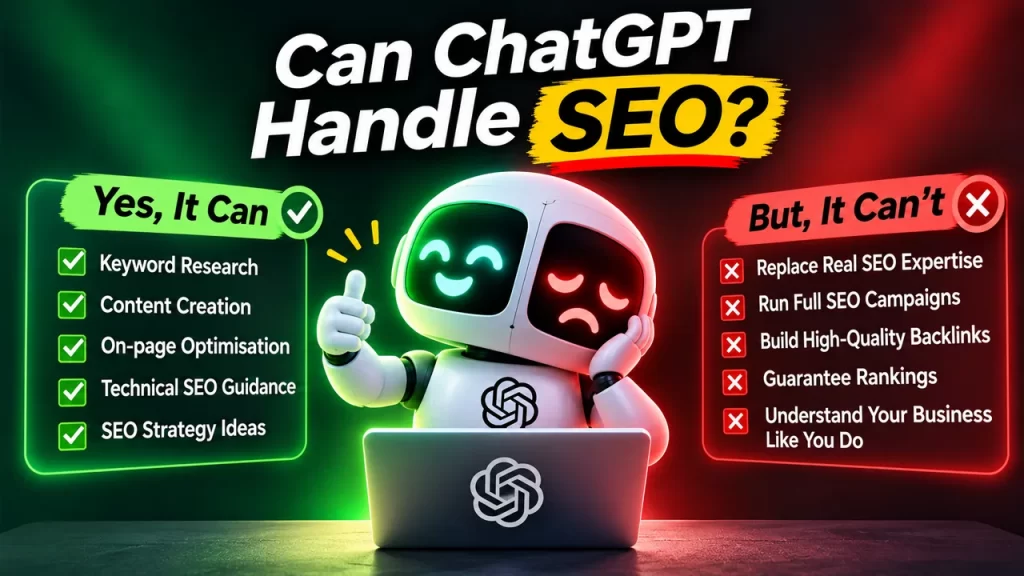
Every SEO student I meet asks the same question in a different form: “If ChatGPT can write content and suggest keywords, why should I learn SEO?” The worry makes sense, because AI content is already everywhere in search. An Ahrefs analysis of 600,000 ranking pages found that 86.5% of top-20 results contain some AI-generated content. The same study found that purely AI-written pages made up only 4.6% of those results and rarely ranked first, and a 2026 follow-up showed that 54.7% of pages in Google’s top three have less than 20% AI-generated text. ChatGPT can do SEO tasks, but it cannot do SEO. It drafts, clusters, summarises and codes in seconds, yet it cannot see your live data, judge business priorities, earn authority or take responsibility for results. The people who rank in 2026 and 2027 use ChatGPT as a fast assistant under human strategy.
TL:DR
ChatGPT handles many SEO tasks well: keyword clustering, content briefs, first drafts, meta tags, schema markup, regex and report summaries. It fails at anything that needs live data, crawling, real search volumes, link building, original experience or accountability. Google does not penalise AI content for being AI; it penalises unhelpful, scaled, low-value content. The winning workflow combines human strategy, real data from tools like Search Console, ChatGPT or Claude for speed, and human editing for experience and accuracy. The next step beyond prompts is building AI SEO agents connected to your data.
What SEO tasks can ChatGPT actually do well?
ChatGPT works best on tasks where you supply the context and it supplies speed. Here is how I rate it after using it daily on client and training projects.
| SEO task | How well ChatGPT does it | What you must still check |
|---|---|---|
| Keyword clustering by intent | Very well, if you paste real keyword data | Whether clusters match the live SERP |
| Content briefs and outlines | Well | Search intent and competitor gaps |
| First drafts | Fair | Facts, experience, originality, tone |
| Title tags and meta descriptions | Very well | Character length and click appeal |
| Schema markup (JSON-LD) | Very well | Validation in Google’s Rich Results Test |
| Regex for Search Console filters | Very well | Test on real data |
| Summarising audits and reports | Well | That nothing important is dropped |
| Topic and FAQ ideas | Well | Real demand from search data |
| Outreach email drafts | Fair | Personalisation for each site |
In short: ChatGPT does keyword clustering, briefs, meta tags, schema, regex and report summaries very well when you give it real data. Drafts, outreach and ideas need heavy human checking for facts, intent and originality.
Where does ChatGPT fail at SEO?
ChatGPT fails wherever SEO needs real-world data, judgement or relationships.
It cannot see your live data by default
ChatGPT does not know your Search Console clicks, your crawl errors or which pages lost rankings last week unless you connect it to that data. Without that context, its advice stays generic.
It guesses search volumes and competition
Ask ChatGPT for search volume and it may give you confident numbers that no tool supports. Always pull volumes from Google Keyword Planner, Semrush or Ahrefs.
It cannot crawl or audit a full website
A technical audit needs a crawler that checks thousands of URLs for status codes, canonicals, redirects and indexability. A chat window cannot replace a crawl.
It writes average content by design
Language models predict likely text, so their default output sounds like everything else on the topic. Average content struggles in a search landscape already full of it.
It cannot build authority or relationships
Backlinks, PR features, podcast invites and partnerships come from people trusting people. ChatGPT can draft the email; it cannot earn the trust.
It takes no responsibility for results
When traffic drops after a core update, a client needs someone who can diagnose the cause, explain it and fix it. That accountability stays with the SEO professional.
In short: ChatGPT fails at SEO when it lacks live data, invents search volumes, cannot crawl sites, produces average content, cannot build relationships and cannot own results. Each gap needs human skill or connected tools.
Does Google penalize ChatGPT-written content?
No, Google does not penalise content just because AI wrote it. Google’s guidance on AI-generated content states that it rewards helpful, high-quality content however it is produced, and that using automation mainly to manipulate rankings violates its spam policies. The ranking data agrees. Ahrefs found a correlation of just 0.011 between the share of AI content on a page and its ranking position, which means effectively no relationship.
The risk lies elsewhere. Sites that publish hundreds of unedited AI pages to capture traffic run into Google’s scaled content abuse policy. And the very top positions still lean toward pages with more human input, which suggests that experience and original insight give pages an edge.
In short: Google does not penalise AI-written content for being AI. It penalises unhelpful and mass-produced content created to manipulate rankings. Data shows no link between AI share and rankings, but top positions favour pages with more human input.
How do you use ChatGPT for SEO step by step?
This is the workflow I use and teach. It works with ChatGPT, Claude or Gemini.
Step 1: Define the business goal yourself
Decide what the page must achieve: leads, sales, sign-ups or brand visibility. AI cannot set priorities for a business it does not understand.
Step 2: Pull real data first
Export keywords from Search Console and a keyword tool, and collect the top-ranking URLs for your target query. Feed this data to ChatGPT instead of asking it to guess.
Step 3: Ask ChatGPT to cluster and find gaps
Paste the keyword list and competitor headings, then ask it to group keywords by intent and list subtopics your competitors miss. A good prompt looks like this: “Group these 120 keywords by search intent, suggest one page per cluster, and flag clusters that need a commercial page instead of a blog.”
Step 4: Build the brief, then the draft
Ask for a brief with question-based headings, the direct answer for each heading, and the entities to cover. Then generate a draft section by section rather than all at once, so you control depth.
Step 5: Add what only you know
Experience and examples
Add your own screenshots, results, client situations, mistakes and opinions. This step turns an average draft into a page worth ranking.
Fact-checking
Verify every statistic, date, price and claim against a primary source. Remove anything you cannot confirm.
Step 6: Let ChatGPT handle the technical extras
Generate FAQ schema, article schema, title variations, meta descriptions and internal link suggestions. You can also use my free schema markup generator and SERP preview tool to check the output.
Step 7: Publish, monitor and refresh
Track impressions, clicks and AI citations in the weeks after publishing. Paste the Search Console data back into ChatGPT and ask which sections to expand or which queries the page almost ranks for.
In short: Use ChatGPT for SEO by setting the goal yourself, feeding it real data, using it for clustering, gap analysis, briefs and section-wise drafts, adding your own experience and verified facts, generating schema and meta tags, and refreshing pages with Search Console feedback.
How do AI SEO agents differ from ChatGPT prompts?
A prompt is a one-time conversation. An AI SEO agent is a system that connects a model like Claude or ChatGPT to your real tools, such as Search Console, GA4 and a crawler, and runs tasks on its own.
| Factor | ChatGPT prompts | AI SEO agents |
|---|---|---|
| Data access | Only what you paste | Live data from GSC, GA4, crawlers |
| Repetition | You repeat every task manually | Runs on a schedule |
| Output | Text in a chat | Reports, alerts, drafts, audits |
| Skill needed | Prompting | Prompting plus basic setup of connections such as MCP servers |
| Example | “Write a meta description” | “Every Monday, find pages that lost clicks and draft fixes” |
This is where SEO careers are heading. In my advanced online SEO training, students learn to build their own AI SEO agents alongside core SEO, GEO and AEO. Founders who want a personal setup for their business can choose the one-on-one SEO training.
Looking ahead to 2027, I expect connected agents to become a normal part of SEO teams, the same way crawlers did a decade ago. ChatGPT also keeps growing as a search destination: in November 2026 OpenAI said its search-like query volume had reached about one-fifth of Google’s. Two skills are worth building now: getting your brand cited inside AI answers, and using AI agents to handle routine SEO work.
In short: ChatGPT prompts handle one task at a time with pasted data, while AI SEO agents connect to live tools like Search Console and GA4 and run tasks automatically. Agent-building is becoming a core SEO skill.
Is AI replacing SEO professionals?
AI is replacing SEO tasks, not SEO professionals. The work that disappears is the repetitive layer: writing meta tags by hand, formatting reports, basic keyword grouping. The work that grows is strategy, technical diagnosis, AI search visibility, brand authority and building automation. An SEO executive who only did manual tasks faces real pressure. An SEO professional who directs AI tools does the work of three people and becomes more valuable to employers. If you want to see the full picture of where the field is going, my SEO courses are built around this shift.
In short: AI removes repetitive SEO tasks and increases the value of strategic, technical and automation skills. SEO professionals who use AI tools become more productive and more employable.
Which ChatGPT SEO mistakes should you avoid?
| Mistake | Why it hurts | What to do instead |
|---|---|---|
| Publishing drafts without editing | Generic, unhelpful pages | Add experience, examples and verified data |
| Trusting AI search volumes | Wrong keyword priorities | Use real keyword tools |
| Mass-producing pages | Risk under scaled content abuse policies | Publish fewer, better pages |
| Ignoring search intent | Wrong page format | Check the live SERP first |
| Copying AI schema blindly | Invalid markup | Validate before publishing |
| Skipping internal links | Weak topical structure | Link related pages deliberately |
In short: Avoid publishing unedited AI drafts, trusting AI-generated search volumes, mass-producing pages, ignoring intent, using unvalidated schema and skipping internal links. Each mistake reduces rankings or creates policy risk.
Frequently asked questions
Can ChatGPT do keyword research?
Partly. ChatGPT can brainstorm seed keywords, group them by intent and suggest long-tail variations, but it cannot give reliable search volumes or difficulty scores. Think of a bakery owner in Indiranagar: ChatGPT suggests “eggless cake near me” and “custom birthday cake Bangalore”, which are good ideas, but only Keyword Planner or Semrush tells you which one people actually search more.
Can ChatGPT write content that ranks on Google?
Yes, ChatGPT-assisted content can rank, but unedited ChatGPT content rarely ranks at the top. Pages rank when they match intent and add value. A travel blogger who uses ChatGPT for the structure and then adds her own hotel photos, prices she paid and mistakes she made gives Google something no other page has.
Is ChatGPT or Claude better for SEO?
Both work well, and the better choice depends on the task. I use Claude for long-form drafting, careful reasoning and building agents through MCP connections to Search Console and GA4, and I use ChatGPT for quick ideation and short copy. Many SEO professionals keep both open and compare outputs on important pages.
Can ChatGPT do a technical SEO audit?
No, ChatGPT cannot run a full technical audit on its own because it cannot crawl your site. It can explain crawl reports, prioritise issues and write fixes once you export data from a crawler or Search Console. Paste a list of 500 redirect chains and it will group them and suggest the fix order in a minute.
How do I get my website mentioned in ChatGPT answers?
You get mentioned in ChatGPT by being visible and trusted across the web: rank well on Google and Bing, earn mentions on respected sites, publish original data, keep brand facts consistent, and structure pages with clear answers. I explain the full process in my guide on how to rank in ChatGPT and Perplexity. If you want hands-on help, start at Mohit’s SEO Training.
Sources

mohitverma
Mohit Verma is the founder and lead trainer of Mohit’s SEO Training, a Bangalore-based AI SEO training institute. With 12+ years of hands-on SEO experience, he has trained 500+ learners since 2022 and also runs the SEO agency Road To Top 5. Connect with him on LinkedIn or YouTube.