
If I had a rupee for every time someone asked me
“Mohit, keyword difficulty is 80… should I avoid it?”
I’d rank for “best SEO consultant in India” just on backlinks alone 😄
So let’s settle this once and for all.
This blog answers one simple question:
What does the keyword difficulty score tell you — and what does it not tell you?
And I’ll explain it the way I explain it to my clients like Byron Bay Airport Transport, Nanak Accountants, and ContactSwing.ai — without jargon, without fear, and without tool worship.
- What Is Keyword Difficulty (In Plain English)?
- What Does the Keyword Difficulty Score Actually Measure?
- Why Keyword Difficulty Alone Can Mislead You (Biggest Gap in Competitor Blogs)
- Keyword Difficulty Range: What the Numbers Really Mean
- How Is Keyword Difficulty Score Calculated?
- Keyword Difficulty vs Keyword Intent (This Is Where Rankings Are Won)
- How I Actually Use Keyword Difficulty in Real SEO Work
- What Keyword Difficulty Doesn’t Measure (Critical Insight)
- What Is a Good Keyword Difficulty for You?
- FAQs
What Is Keyword Difficulty (In Plain English)?
Let’s skip the textbook definition for a moment.
Keyword difficulty meaning is simple:
It tells you how hard it may be to rank on Page 1, based on who already ranks there.
Think of keyword difficulty like a gym machine weight label.
Just because a machine says 80 kg doesn’t mean:
- You can’t lift it
- Or you shouldn’t try it
It only tells you:
👉 How much effort might be required
That’s it.
What Does the Keyword Difficulty Score Actually Measure?
Different tools calculate keyword difficulty score meaning differently, but most focus on one thing:
👉 Competition strength of existing ranking pages
This usually includes:
- Number of backlinks
- Authority of ranking domains
- Link profiles
- Sometimes SERP features
For example:
What is KD in Ahrefs?
Ahrefs keyword difficulty score focuses almost entirely on backlinks pointing to the top-ranking pages.
Moz difficulty score?
Moz mixes:
- Page Authority
- Domain Authority
- Link metrics
So when people ask:
“How is keyword difficulty calculated?”
The honest answer is:
It’s an estimate, not a verdict.
Why Keyword Difficulty Alone Can Mislead You (Biggest Gap in Competitor Blogs)
Most blogs stop here.
I don’t.
Here’s what they don’t tell you 👇
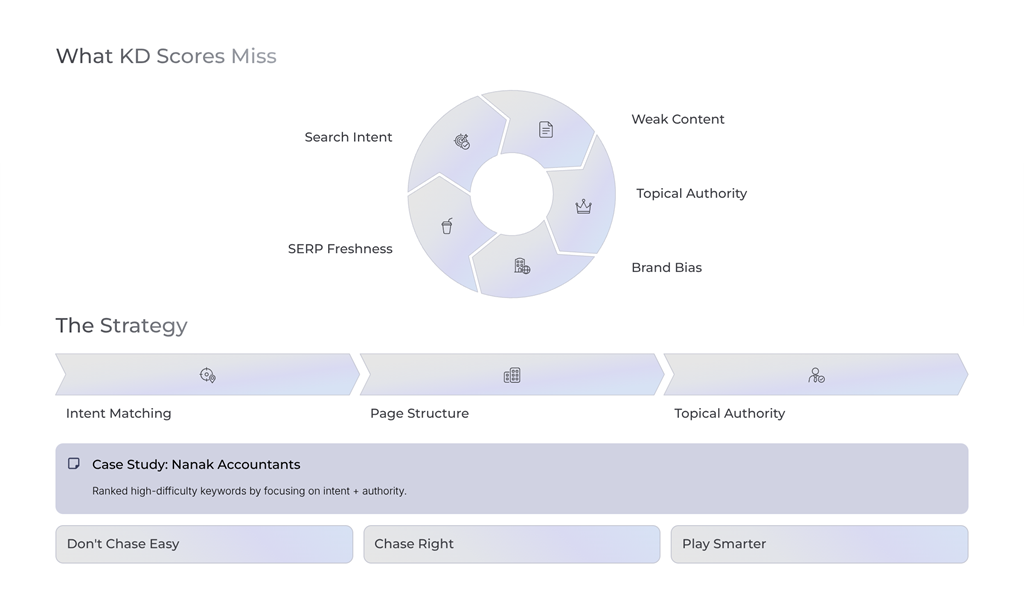
❌ Keyword difficulty ignores:
- Search intent mismatch
- Weak content on Page 1
- Topical authority
- Brand bias
- SERP freshness
I’ve ranked “high keyword difficulty” keywords for clients by:
- Creating better intent-matched content
- Structuring pages smarter
- Building topical authority first
This is exactly what we did for Nanak Accountants — instead of chasing “easy” keywords, we chased right ones.
Keyword Difficulty Range: What the Numbers Really Mean
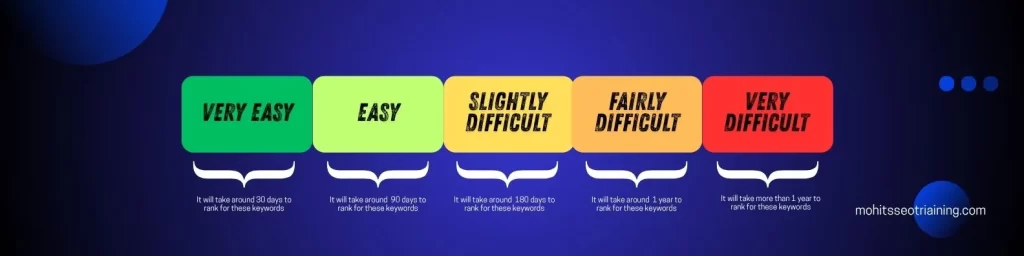
Let me simplify the keyword difficulty range the way I teach students:
| KD Range | What It Really Means |
| 0–10 | Low competition, usually long-tail |
| 11–30 | Achievable for newer sites |
| 31–50 | Needs authority + good content |
| 51–70 | Competitive but possible |
| 71+ | Strong brands or strong strategy needed |
So when someone asks:
What is a good keyword difficulty score?
My answer is always:
It depends on your website, not the number.
How Is Keyword Difficulty Score Calculated?
Let me clear one big myth first 👇
There is no single Google-approved formula for keyword difficulty.
When people ask me “How keyword difficulty score is calculated?”, what they really mean is:
“What signals do SEO tools use to guess how hard ranking will be?”
So here’s how it actually works in the real world.
The Simple Explanation (No Math Headache)
Keyword difficulty score is a prediction, not a promise.
SEO tools look at the current top-ranking pages and ask:
- How strong are these pages?
- How many backlinks do they have?
- How trusted are their domains?
Then they convert that data into a difficulty number.
That’s it.
No magic.
No Google leak.
Just math + assumptions.
The Core Factors Used in Keyword Difficulty Calculation
Most tools calculate keyword difficulty using a mix of these signals:
🔹 Backlinks to Ranking Pages
More quality backlinks = higher difficulty
If page #1 has:
- 5 backlinks → easier competition
- 500 backlinks → welcome to the gym 🏋️
🔹 Domain Authority / Domain Rating
Stronger domains raise the difficulty score
Ranking against:
- Blogs → manageable
- Forbes, HubSpot, Amazon → pain guaranteed
🔹 Page Authority
Sometimes weak domains rank because that specific page is strong.
Tools factor this in.
🔹 SERP Composition
If the first page is filled with:
- Ads
- Featured snippets
- Big brands
Difficulty goes up even if backlink count looks low.
A Sample Keyword Difficulty Calculation (Illustrative)
Let’s say we analyze a keyword and see this:
| Ranking Page | Backlinks | Domain Rating |
| Page 1 | 120 | 82 |
| Page 2 | 95 | 76 |
| Page 3 | 60 | 71 |
| Page 4 | 40 | 68 |
| Page 5 | 25 | 64 |
Most SEO tools will:
- Take backlink averages
- Weigh domain authority
- Compare competitiveness across the SERP
👉 Final output might look like:
Keyword Difficulty Score: 58
That doesn’t mean you can’t rank.
It means you’ll need strong content + authority + patience.
Keyword Difficulty vs Keyword Intent (This Is Where Rankings Are Won)
Here’s a real-world example.
A keyword with:
- KD 60
- Clear transactional intent
- Weak landing pages ranking
…is often easier than a KD 20 keyword dominated by:
- Government sites
- Wikipedia
- Big publishers
This is why keyword difficulty analysis without intent is incomplete.
If you’re still unclear on intent types, this breakdown helps:
👉 https://mohitsseotraining.com/blog/seo/types-of-keywords-in-seo-with-example/
How I Actually Use Keyword Difficulty in Real SEO Work
Here’s my real workflow 👇
Step 1: Understand keyword intent
Step 2: Check who ranks (manual SERP review)
Step 3: Compare content depth
Step 4: Match against domain authority
Step 5: Decide effort vs ROI
This connects deeply with:
👉 https://mohitsseotraining.com/blog/seo/the-importance-of-keyword-research/
👉 https://mohitsseotraining.com/blog/seo/how-keyword-research-is-done/
Keyword Competition Score Is Not Your Enemy
Many founders panic when they see:
- Ahrefs keyword difficulty score: 65
- Moz difficulty score: High
But here’s the truth:
Keyword difficulty doesn’t block ranking. Poor strategy does.
I’ve seen:
- KD 15 keywords fail due to wrong intent
- KD 55 keywords convert leads due to strong positioning
What Keyword Difficulty Doesn’t Measure (Critical Insight)
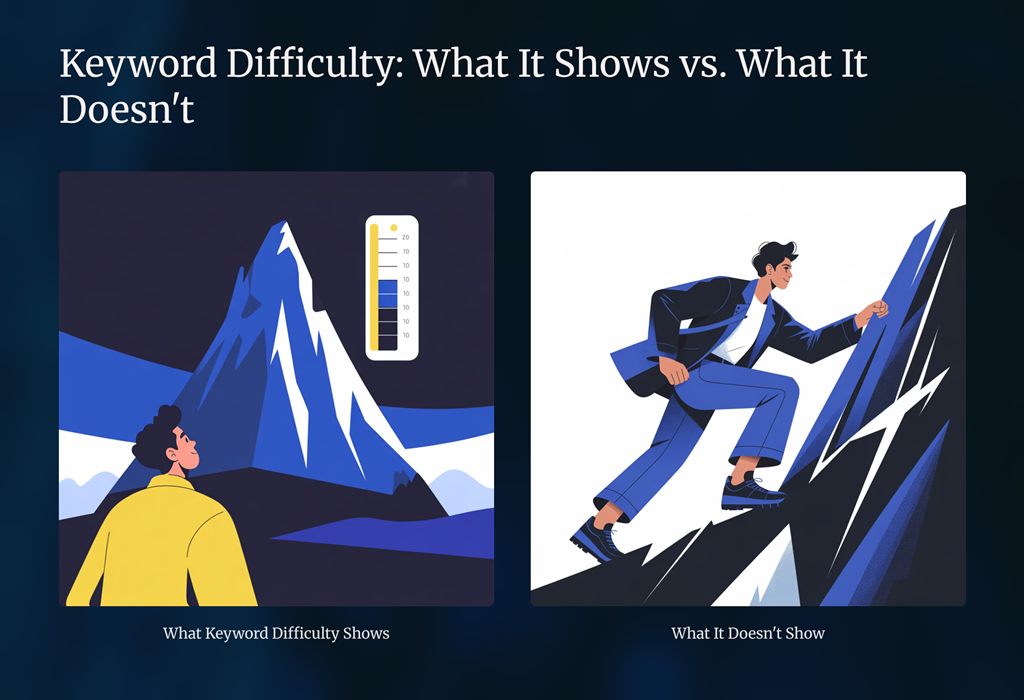
Keyword difficulty does not account for:
- Content freshness
- UX
- Internal linking
- Keyword prominence
- Keyword proximity
If you don’t understand those, difficulty scores won’t save you:
👉 https://mohitsseotraining.com/blog/seo/keyword-prominence-in-seo/
👉 https://mohitsseotraining.com/blog/seo/keyword-proximity-in-seo/
What Is a Good Keyword Difficulty for You?
Let me simplify this question:
New site?
👉 KD 10–30
Growing site?
👉 KD 20–50
Authority site?
👉 KD 40–70+
This is why what is meant by keyword difficulty changes based on who you are.
Keyword Difficulty Is a Planning Tool — Not a Stop Sign
I’ll say this clearly:
Keyword difficulty tells you how hard the fight is — not whether you should fight.
SEO success comes from:
- Smart selection
- Intent match
- Execution quality
Not from avoiding competition forever.
FAQs
What does the keyword difficulty score tell you?
The keyword difficulty score tells me how hard Google will make my life for a keyword 😄
More practically, it estimates how competitive a keyword is by looking at:
- The authority of pages already ranking
- The number and quality of backlinks they have
- How crowded the SERP looks overall
I treat it as an effort meter, not a success predictor.
It answers one simple question for me:
“How much SEO muscle will I need to flex to rank here?”
It does not tell me whether I can’t rank.
It only tells me how much work I should expect.
What is a good keyword difficulty score?
There is no universally “good” keyword difficulty score.
Anyone telling you otherwise is oversimplifying SEO.
From my experience:
- 0–20 → Low competition (great for new or lean websites)
- 21–50 → Medium competition (perfect for growing sites)
- 51+ → High competition (needs authority, links, and patience)
A keyword is “good” when the effort matches my site’s strength, not when the number looks small.
I’ve ranked medium and high KD keywords simply because the intent and content alignment were strong.
What is the 80/20 rule in SEO?
The 80/20 rule in SEO shows up everywhere once you pay attention.
Roughly:
- 20% of keywords drive 80% of traffic or leads
- Most keywords look nice in reports but do nothing for revenue
I use this rule to stop wasting time.
Instead of chasing every keyword:
- I double down on keywords that convert
- I ignore vanity volume that never brings business
SEO works best when I optimize for outcomes, not spreadsheets.
Should keyword difficulty be high or low?
Keyword difficulty should match where my website stands today.
Here’s how I look at it:
- Low KD → Quick wins and confidence boosters
- Medium KD → Sustainable growth
- High KD → Long-term authority and brand positioning
I don’t avoid high difficulty keywords just because they look scary.
I avoid them only when the ROI or timing doesn’t make sense.
SEO is strategy, not fear management.
Quick expert tip
Never judge a keyword by difficulty alone.
Always combine it with:
- Search intent
- Content quality on ranking pages
- Your domain authority
- Business value
That’s how real SEO decisions are made.