

If you’ve ever tried to rank a website on Google, you’ve probably heard the phrase: “It all starts with the right keyword.” But what does that actually mean?
In the world of SEO, not all keywords are created equal. Some bring in curious browsers, others attract ready-to-buy customers. Some are broad and vague, while others are laser-focused. Knowing the different types of keywords in SEO — and how to use them — can be the difference between a page that ranks and one that disappears into search engine oblivion.
In this blog, we’ll break down the types of keywords in SEO with examples, explore why they matter, and show you how to naturally fit them into your content strategy. Whether you’re a student learning SEO from scratch or a manager refining your digital marketing playbook, this guide will help you understand the real power behind smart keyword usage.
Let’s dive in.
In this blog, we’ll break down:
What are Keywords in SEO?
How Many Types of Keywords Are in SEO with Examples?
App Store Keywords (Bonus for Mobile SEO)
What Are the 4 Main Types of SEO and How Do They Use Different Keyword Strategies?
Where Else Can You Use Keywords?
What Are Keywords in SEO?
At its core, a keyword in SEO is the word or phrase people type into search engines to find what they’re looking for. Think of them as the bridge between what people want and what your content provides.
For example:
If someone types “best budget headphones for gaming,” that entire phrase is a keyword — more specifically, a long-tail, transactional keyword. More on that below!
How Many Types of Keywords Are in SEO with Examples?
You’ve probably heard the term “keywords” tossed around a lot in digital marketing. But here’s the thing — not all keywords are the same. In fact, based on industry standards and SEO practices, there are 8 main types of keywords, each serving a different purpose in your strategy.
Let’s break them down based on 4 key categories:
1. Based on User Intent
Understanding what the user wants when they search helps tailor content more effectively.
- Informational Keywords: Used when the user wants to learn something.
Example: “How to improve SEO ranking” - Transactional Keywords: Used when the user is ready to buy or take action.
Example: “Buy noise cancelling headphones online” - Commercial Investigation Keywords: When the user is comparing or researching before buying.
Example: “Best laptops under 60000 in India” - Navigational Keywords: When the user wants to reach a specific website or brand.
Example: “Nike official site”
2. Based on Keyword Length (Tail)
This classification helps define how specific or broad a search query is.
- Short-tail Keywords: 1–2 words, high volume, low intent
Example: “Shoes” - Medium-tail Keywords: 2–3 words, moderate volume, more focused intent
Example: “Running shoes for men” - Long-tail Keywords: 4+ words, low volume, high intent, highly specific
Example: “Best running shoes for flat feet under 5000”
3. Based on Usage in Content
Helps structure your SEO content strategy properly.
- Primary Keywords: The main focus of a page. It defines the core topic.
Example: “Digital marketing agency in Mumbai” - Secondary Keywords: Supporting keywords that enhance relevance.
Example: “Online marketing services”, “performance marketing in Mumbai”
4. Based on Branding
Focuses on whether the keyword includes a brand name or not.
- Branded Keywords: Includes your brand name or a competitor’s.
Example: “Zara summer collection 2025” - Non-Branded Keywords: Generic keywords without brand names.
Example: “Affordable summer dresses”
Summary Table: Types of Keywords in SEO
| Category | Keyword Type | Example |
| Intent | Informational, Transactional, Commercial, Navigational | “How to improve SEO” / “Buy LED TV” |
| Length (Tail) | Short-tail, Medium-tail, Long-tail | “Shoes” / “Running shoes for men” / “Best waterproof hiking boots for snow” |
| Usage | Primary, Secondary | “SEO services India” / “Link building agency” |
| Branding | Branded, Non-Branded | “Apple MacBook” / “Best laptops for students” |
1. Informational Keywords
These are used when people want to learn something.
Examples:
- “How to do keyword research”
- “What is on-page SEO”
Intent: Top of the funnel (TOFU) – users are just starting to explore.
2. Navigational Keywords
These are brand or site-specific. Users already know where they want to go.
Examples:
- “Ahrefs login”
- “Backlinko blog”
Intent: Mid-funnel – the user is trying to find a particular page.
3. Transactional Keywords
These signal a strong buying intent.
Examples:
- “Buy Bluetooth speakers online”
- “Cheap web hosting plans”
Intent: Bottom of the funnel (BOFU) – ready to convert.
4. Commercial Keywords
Used by people researching before making a purchase.
Examples:
- “Best email marketing tools 2025”
- “Top-rated SEO plugins”
Intent: Middle of the funnel – exploring options.
5. Long-Tail Keywords
These are longer, more specific search phrases.
Examples:
- “Best running shoes under ₹3000 for flat feet”
- “How to fix Shopify checkout issues in India”
Benefit: Lower competition + high intent = better conversions
6. Short-Tail Keywords
Short and broad search queries. High volume but competitive.
Examples:
- “Laptops”
- “Shoes”
Tip: Good for awareness but not for immediate conversions.
7. LSI Keywords (Latent Semantic Indexing)
These are conceptually related terms search engines use to understand context.
Example for “digital marketing”:
- SEO, PPC, content marketing, backlinks, traffic
Tip: Naturally include them to enhance topical relevance.
8. App Store Keywords (Bonus for Mobile SEO)
If you’re into mobile marketing, app store keyword ranking matters too.
Examples:
- “budget tracker app”
- “daily fitness app India”
Platform: Google Play, Apple App Store, and SEO for app visibility
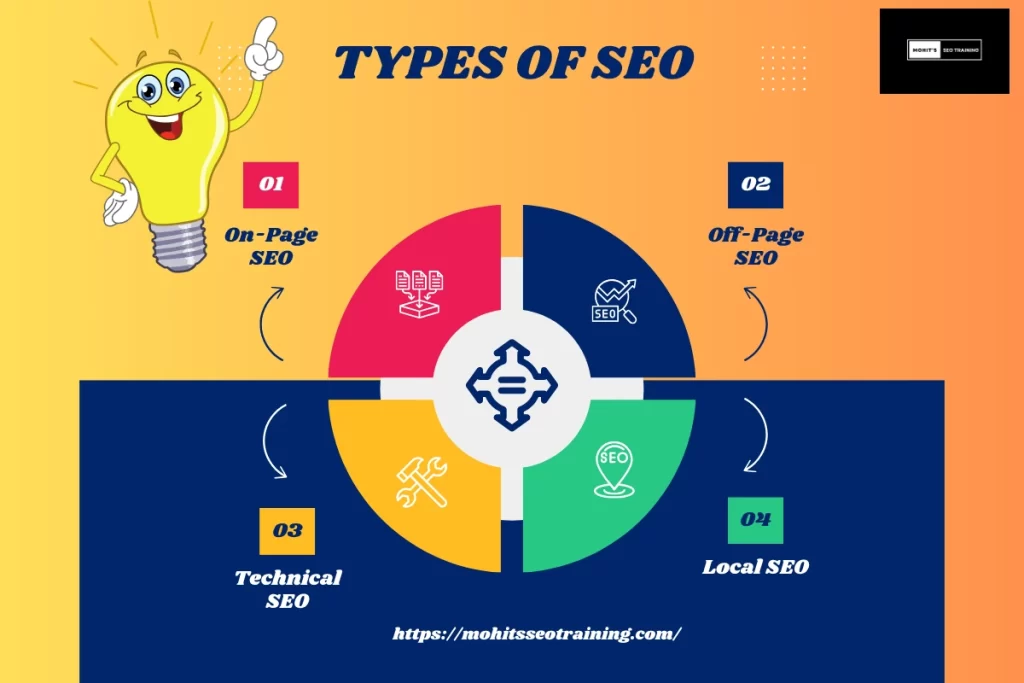
What Are the 4 Main Types of SEO and How Do They Use Different Keyword Strategies?
Yes, even the types of SEO influence how you use keywords:
| SEO Type | Focus Area | Example Keyword Strategy |
| On-Page SEO | Content, meta, headers | Informational + Long-Tail |
| Off-Page SEO | Backlinks, brand mentions | Commercial + Navigational |
| Technical SEO | Site speed, schema, indexing | LSI + Structured keywords |
| Local SEO | Maps, location-specific searches | best dentist in Bandra |
Where Else Can You Use Keywords?
Beyond the core SEO types, keywords also play a crucial role in:
- International SEO: Use hreflang tags and region-specific keywords (e.g., “online course UK” vs. “online course India”)
- Native SEO: Focus on local dialects, language-specific queries, and cultural relevance
- White Hat SEO: Naturally incorporate keywords in valuable, user-focused content
- Black/Grey Hat SEO (Not recommended): Often involve keyword stuffing or cloaking, which violate Google’s guidelines
Real-Life Example:
One of our clients (a D2C skincare brand) ranked for both short and long-tail keywords like:
- “face serum” (short-tail, high volume)
- “best face serum for dry skin India” (long-tail, highly converting)
After optimizing content with the right mix of keyword types in SEO, their organic traffic grew 68% in 3 months.
Final Thoughts: Why Knowing Keyword Types in SEO Matters
Understanding the types of keywords in SEO with example isn’t just theory — it’s strategy.
By knowing what are the different types of keywords, you can:
- Target each stage of the buyer journey
- Improve content relevance and user experience
- Boost search visibility with less competition
Ready to Power Up Your SEO?
Whether you’re just learning how many keywords for SEO you should focus on or want to revamp your existing strategy, using the right keyword mix makes all the difference.
Need help mapping keyword types to your business? Drop us a message — we’re happy to help!
FAQs
1. What are the main types of keywords in SEO?
The main types of keywords in SEO include Informational, Navigational, Transactional, Commercial, Short-tail, Long-tail, Branded, Non-Branded, Primary, Secondary, and LSI keywords. Each type serves a specific purpose in the user journey and content strategy.
2. How many keywords should I use for SEO?
There’s no fixed number, but ideally, one primary keyword and 2–4 secondary keywords should be naturally included in each page or blog post. Long-form content may allow for more, as long as it remains natural and useful.
3. What is the difference between short-tail and long-tail keywords?
Short-tail keywords are 1–2 word phrases like “laptops” — broad and competitive. Long-tail keywords are more specific phrases like “best laptops under 60000 in India,” which have lower competition and higher conversion intent.
4. Why are transactional keywords important for SEO?
Transactional keywords signal strong purchase intent. Targeting them helps attract users who are ready to buy, making them crucial for e-commerce SEO and bottom-of-the-funnel content strategies.
5. How do I find the right keywords to use?
You can use tools like Google Keyword Planner, SEMrush, Ahrefs, or Ubersuggest to find keyword ideas based on search volume, difficulty, and user intent. Always align your keyword strategy with your target audience’s needs and your business goals.

Mohit Verma I am an experienced professional with 9+ years of experience in Search Engine Optimization. I am on a mission to provide industry focused job oriented SEO so the students/mentees can get their dream SEO job and and start working from day 1.