When I hear someone say they bought an SEO course on Udemy, the first thing I ask is not whether the course is good. I ask which course they bought. That’s because Udemy is not a single course or structured program. It is a marketplace where anyone can publish a course, and that changes the entire learning experience.
While evaluating this Udemy SEO course review, I did not look at one specific course. I looked at how the platform works for someone trying to learn SEO seriously. And that’s where most people make a mistake. They assume the platform guarantees quality, but in reality, the outcome depends entirely on the instructor they choose.
History of the Course
Before I form an opinion on any course, I always check who is behind it. In SEO, real-world experience matters far more than how well content is presented.
Udemy has built itself as one of the largest online learning platforms globally, offering courses across coding, marketing, business, and more. SEO is just one category within this massive ecosystem. Unlike specialized training platforms, Udemy does not create its own standardized curriculum. Instead, it allows instructors to design and publish their own courses.
The founders of Udemy come from a strong background in building scalable education platforms. Their focus has always been on accessibility and reach, not necessarily domain specialization like SEO. This means the platform excels at distributing knowledge, but the depth and quality of that knowledge depend entirely on the instructor.
That is why, when it comes to SEO, I don’t evaluate Udemy as a platform. I evaluate the individual course creator. And that distinction becomes critical as I move further into the analysis.
What They Promise vs What You Actually Get
Most Udemy SEO courses follow a familiar pattern in terms of promises. They claim to teach SEO from scratch, help rank websites, and make learners job-ready. On the surface, this sounds complete and appealing, especially for beginners.
In practice, the experience varies significantly. Some courses do a good job of explaining concepts like keyword research, on-page optimization, and basic link building. They provide a structured introduction that helps someone understand how SEO works.
However, the gap appears when it comes to execution. The transition from understanding SEO to actually applying it on a live website is rarely covered in depth. Many courses remain focused on explanation rather than implementation. This creates a situation where learners feel confident while consuming content but struggle when they try to execute SEO independently.
Points I Judged the Course At
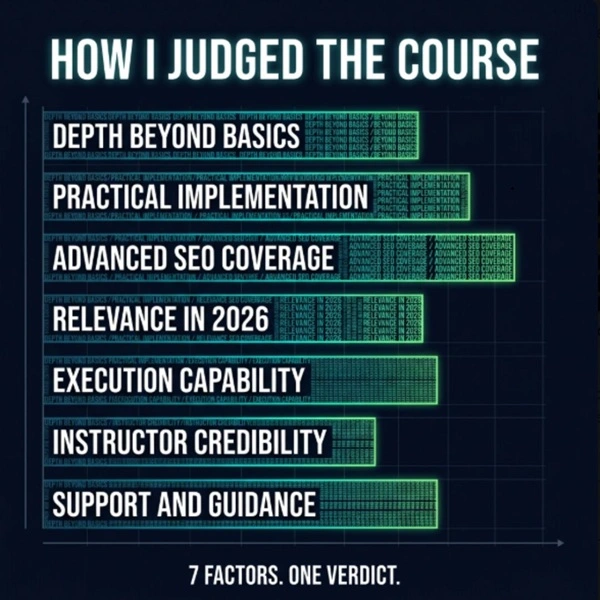
Before I break down anything, I always define how I evaluate an SEO course. I don’t look at how well it is explained. I look at whether it can help me execute SEO in real scenarios.
Here are the parameters I use:
- Depth beyond basics
I check whether the course goes beyond definitions and actually teaches strategy and execution. - Practical implementation
I evaluate whether the course includes real projects, audits, and hands-on exercises. - Advanced SEO coverage
I look for topics like technical SEO, semantic SEO, programmatic SEO, and AI workflows. - Relevance in 2026
I assess whether the content aligns with current SEO trends and algorithm changes. - Execution capability
I check if I can rank a website independently after completing the course. - Instructor credibility
I evaluate whether the instructor has real-world SEO experience or just teaching knowledge. - Support and guidance
I look for mentorship, doubt-solving systems, and structured learning paths.
If a course fails on these, it may teach concepts, but it won’t build real SEO capability.
Course Curriculum Breakdown
Since Udemy is a marketplace, the curriculum is not standardized. However, most SEO courses follow a similar structure. Here’s how I evaluate it:
- Introduction to SEO
Most courses start with basic concepts, which helps in understanding the foundation but does not connect directly with execution. - Keyword Research Basics
The focus is usually on tools and keyword discovery, but deeper aspects like search intent, clustering, and keyword mapping are often missing. - On-Page SEO
Concepts like titles, meta tags, and headings are explained, but advanced optimization strategies and real implementation are rarely covered. - Off-Page SEO
Backlinks are discussed, but modern link-building techniques and authority-building strategies are not explored in depth. - Technical SEO (Limited)
Some courses touch technical SEO, but very few go deep into crawling, indexing, and site structure. - SEO Tools Overview
Tools are introduced, but there is little focus on using them to solve real SEO problems. - Freelancing / Career Modules
These sections exist in some courses, but they are often generic and not actionable. - Lack of Real Project Execution
The biggest gap is the absence of working on live websites, which is essential to build real skills.
Overall, the curriculum builds awareness but does not prepare me for real-world execution.
Practical Learning vs Theory
SEO cannot be mastered through theory alone. Understanding concepts is important, but execution is what builds skill. When I compare both approaches, the difference becomes very clear.
| Aspect | Practical Learning | Theory-Based Learning |
|---|---|---|
| Learning Approach | Hands-on execution on real websites | Watching videos and understanding concepts |
| Skill Development | Builds real problem-solving ability | Builds conceptual clarity only |
| Confidence Level | High due to real experience | Drops when applied practically |
| SEO Understanding | Deep and result-oriented | Surface-level understanding |
| Outcome | Ability to rank websites | Ability to explain SEO |
Most Udemy courses lean heavily toward theory, and that is where the gap starts.
Biggest Problems Students Face
Inconsistent Course Quality
Since Udemy allows anyone to publish a course, the quality varies significantly. Some instructors provide structured learning, while others deliver outdated or surface-level content. This inconsistency makes it difficult for learners to trust the platform or make the right choice.
Lack of Practical Exposure
Most courses focus on explanation rather than execution. Without working on real websites, learners struggle to apply concepts in real scenarios. This creates a gap between understanding and implementation.
Outdated SEO Strategies
SEO evolves rapidly, but not all instructors update their content regularly. This leads to learners following strategies that may no longer be effective, which can impact results.
Overconfidence Without Skill
Many learners complete a course and feel they understand SEO. However, when they try to execute it, they realize they lack the practical experience required to achieve results.
Certification Without Real Value
Completing a course provides a certificate, but it does not guarantee skill. In SEO, results matter more than certifications, and this gap becomes evident when learners step into real-world scenarios.
Top Udemy SEO Courses to Checkout
If someone still wants to explore Udemy, choosing the right course becomes critical because the quality depends entirely on the instructor.
| Course Name | Instructor | Pros | Cons | Cost | Ratings |
|---|---|---|---|---|---|
| SEO Training Masterclass | Alex Genadinik | Detailed, beginner-friendly | Limited advanced depth | Low | 4.4/5 |
| SEO 2026 Complete Training | Arun Nagarathanam | Updated content, structured | Surface-level execution | Low | 4.5/5 |
| SEO Tutorial for Beginners | Laurence Svekis | Easy to understand | Very basic | Low | 4.3/5 |
| Advanced SEO Course | Joshua George | Covers broader topics | Not deeply practical | Low | 4.5/5 |
These courses can help build foundational understanding, but they should not be considered complete SEO training programs.
Who Should Buy Udemy SEO Courses
Udemy works well for someone who is completely new to SEO and wants to explore the field without making a large investment. It provides an affordable entry point and helps build basic understanding before moving into deeper learning.
Who Should Avoid It
Udemy is not suitable for someone who wants to become a professional SEO or work with clients. It also does not work for those who need structured guidance, mentorship, or real-world execution training.
Better Alternatives to Skyrocket Your SEO Learnings
If the goal is to build real SEO skills, these alternatives provide better value.
| Course Name | Pros | Cons | Cost | Ratings |
|---|---|---|---|---|
| Mohit’s SEO Training | Practical, real execution, advanced | Requires effort | Premium | 4.8/5 |
| Authority Hacker | Strong fundamentals | Expensive | High | 4.5/5 |
| Semrush Academy | Free, tool-based | Limited depth | Free | 4.2/5 |
| Ahrefs Course | Beginner-friendly | Not advanced | Free | 4/5 |
| Traffic Think Tank | Advanced strategies | Very expensive | High | 4.6/5 |
My Final Verdict
Udemy SEO courses are not bad, but they are not reliable as a complete learning solution. The biggest issue is inconsistency, as the quality depends entirely on the instructor.
If I approach Udemy with the right expectations, it can serve as a starting point. However, it cannot replace structured, execution-focused training.
I would rate Udemy SEO courses overall 2.5 out of 5.


Mohit Verma
Contributor at Mohit's SEO Training.